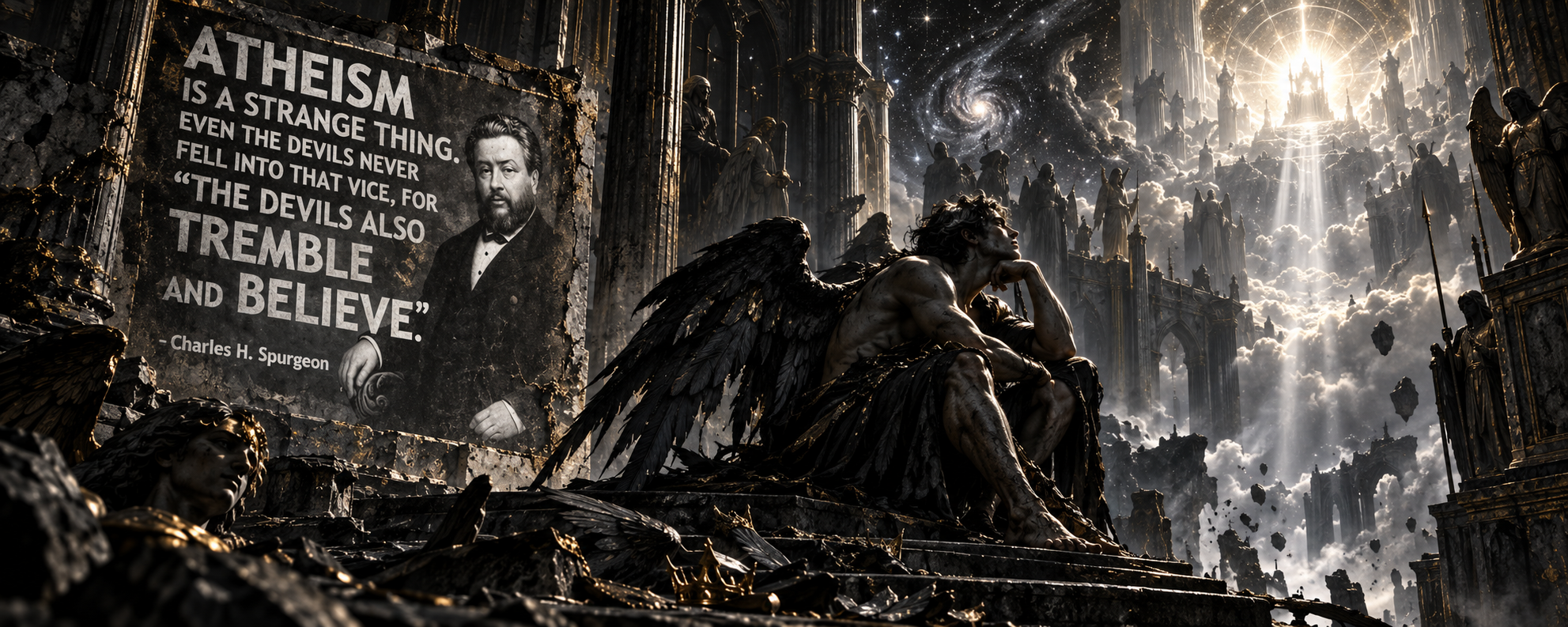
There is a splendidly odd theological problem hidden inside a rather ordinary Christian meme.
Charles Spurgeon is quoted as saying: “Atheism is a strange thing. Even the devils never fell into that vice, for ‘the devils also tremble and believe.’”
The biblical allusion is James 2:19: “Thou believest that there is one God; thou doest well: the devils also believe, and tremble.”
As rhetoric, the point is straightforward. Mere intellectual belief in God isn't enough. Demons believe in God and remain demons. Faith, therefore, must involve rather more than accepting the proposition “God exists”.
Fair enough. Unfortunately, once the demons have been invited into the argument, they behave rather badly.
For they appear to know that God exists. They have, on most traditional Christian accounts, vastly better evidence of God than any human being possesses. Some supposedly stood in God's presence. They knew divine authority directly, experienced the supernatural order at first hand, and nevertheless rebelled.
And they apparently retained free will while doing so.
That creates problems for several familiar explanations of why God remains rather less conspicuous to the rest of us.
The Remarkably Well-Informed Opposition
Christian theology has never generally imagined Satan as an atheist.
The Devil's difficulty isn't insufficient evidence.
He doesn't appear to be sitting in Hell complaining that the cosmological argument has an illicit move from contingency to necessity. The demons aren't waiting for better textual criticism of Mark. They know.
That is the whole point of James's remark. Belief in the bare existence of God is so insufficient to Christian faith that even demons qualify.
Christian tradition commonly goes further. Satan and the fallen angels were originally members of the heavenly order. Whatever precisely we make of biblical material later developed into the doctrine of angelic rebellion, these aren't creatures who encountered ambiguous religious traditions, conflicting scriptures and unusually confident people on Twitter.
They had rather better access to the relevant evidence.
Yet they rebelled.
This means Christian theology already contains a class of rational agents for whom three things are simultaneously true: God's existence is known; God's authority is recognised; rejection remains possible. That combination becomes unexpectedly important.
The Divine Hiddenness Problem Acquires Wings
One popular reply to the problem of divine hiddenness says that God cannot make his existence too obvious without compromising human freedom.
If God appeared unmistakably, the argument goes, belief would become compulsory. We would no longer be free to accept or reject him.
This has always struck me as an odd conception of freedom. I know that HM Revenue & Customs exists without thereby feeling irresistible affection for it.
Knowledge that somebody exists doesn't determine one's attitude towards them.
The fallen angels make the problem considerably worse.
If Satan knew perfectly well that God existed and nevertheless rebelled, then knowledge of God's existence plainly doesn't eliminate the possibility of rejection. Indeed, Christian mythology supplies almost the ideal counterexample.
Lucifer doesn't lack evidence. Lucifer lacks obedience.
So if direct awareness of God was compatible with angelic freedom, why would substantially clearer evidence destroy human freedom?
One might reply that angelic and human cognition differ profoundly. They probably do, assuming angels exist at all. Medieval theology certainly thought so. Aquinas regarded angelic intellect as radically unlike embodied human cognition, with angels apprehending truths more directly rather than reasoning discursively through sensory experience.
But that doesn't rescue the basic argument. If freedom requires epistemic uncertainty for humans but not for angels, an explanation is required for why. It cannot simply be asserted when convenient.
Apparently God Can Be Known and Rejected
There is an important distinction here which much apologetics blurs.
One can believe that a person exists while disliking them. One can know that a ruler possesses authority while refusing obedience. One can recognise that an action has consequences and perform it anyway. Human beings demonstrate all three with tedious regularity.
Christian demonology merely extends this into heaven.
Satan's rebellion makes sense only if knowledge and allegiance are distinct. Indeed, if Satan genuinely believed God didn't exist, rebellion becomes rather difficult to understand. One cannot meaningfully revolt against an entity one regards as fictional.
The traditional story therefore requires considerable theological clarity on Satan's part. He knows whom he is rejecting.
Which rather destroys the idea that God's hiddenness is necessary to preserve the possibility of rejection. God could presumably provide humanity with overwhelming evidence of his existence and still leave us entirely free to say: “Yes, I know. I still don't approve.” Satan apparently did.
The Curious Case of the Angelic Fall
At this point another difficulty appears. Why did the angels rebel?
The answers become increasingly interesting. Christian tradition has proposed pride, envy, the desire for equality with God, rejection of God's plan, refusal to serve humanity, or some combination of these.
But consider the situation. We are supposedly dealing with extraordinarily intelligent beings who knew God, understood the structure of reality far better than we do, and knew that opposition to God was ultimately futile. And some rebelled anyway.
This leaves several possibilities. Perhaps angelic rationality is astonishingly poor. Perhaps pride can overwhelm virtually unlimited knowledge. Perhaps angels didn't fully understand the consequences. Perhaps God permitted some extraordinary defect in their decision-making. Or perhaps rebellion against God isn't quite as obviously irrational as later theology would like it to be.
That last possibility is rarely advertised on church noticeboards. If angels possessing vastly superior information could regard rebellion as worth attempting, one rather wants to see the minutes of the meeting.
Was Satan's Choice Rational?
Traditional Christianity usually regards Satan's rebellion as the ultimate irrational act. But “irrational” can mean several things.
An action may fail to maximise self-interest. It may be based on false beliefs. It may pursue an incoherent objective. Or it may simply pursue values we reject. Those aren't identical.
Suppose Satan knew perfectly well that God was more powerful. That would make victory unlikely, perhaps impossible. It wouldn't necessarily make resistance irrational if Satan valued independence above survival. A doomed rebellion can still be intelligible. Human history contains enough examples.
Christianity itself admires martyrs who refuse submission to overwhelming earthly power because they regard obedience as morally unacceptable. There is therefore something slightly awkward about declaring resistance intrinsically irrational merely because the opponent happens to be omnipotent.
Power settles what can be achieved. It doesn't settle what ought to be desired.
Which raises the rather impolite question of whether Satan's sin was fundamentally epistemic, moral, political or simply jurisdictional. “Non serviam” - “I will not serve” - is not traditionally biblical Satanic dialogue, but it expresses the later mythology remarkably well. It is a declaration of independence. A catastrophically unsuccessful one, admittedly.
The First Dissident?
This interpretation produces a wonderfully heretical reversal.
Suppose Satan knew God existed, understood divine authority and refused submission anyway. Then Satan is not Christianity's first atheist. He is its first conscientious objector.
That doesn't make him right. Traditional Christian theology can reply that God is perfectly good, so opposition to God is necessarily opposition to goodness itself.
But now the argument depends on God's moral character rather than merely God's existence. And that is precisely the distinction the meme accidentally exposes. “The demons believe” establishes that existence isn't enough. One must still determine whether God deserves worship.
That question can't be answered merely by demonstrating power, authorship or metaphysical necessity. A creator could exist and be morally defective. A creator could exist and be indifferent. A creator could exist and deserve respect but not worship. A creator could exist and be opposed for perfectly intelligible reasons.
Christian theology denies these possibilities of its God, naturally. But it must deny them by argument. Satan already knows the cosmological argument's conclusion. Apparently it didn't settle the matter.
Hell and the Problem of Informed Consent
Things become stranger still once eternal punishment enters the picture.
If the fallen angels knowingly rejected God while fully understanding the consequences, their decision represents perhaps the most extreme case of informed consent imaginable. They knew God. They knew Heaven. They presumably knew something about Hell. And they chose rebellion.
What exactly did they think they were choosing?
If their intellects were as powerful as classical theology suggests, “they simply made a stupid mistake” seems oddly inadequate. An eternal intellect choosing eternal ruin requires explanation.
Augustine and Aquinas both wrestled with the peculiar permanence of angelic choice. Aquinas, in particular, held that angelic decisions differ from human decisions because angels don't deliberate through changing bodily passions and incomplete sensory knowledge in quite the way we do. Their fundamental choices therefore possess a kind of fixity.
This produces another difficulty. If angels are created such that one decision can become permanently determinative, then God created beings whose psychology allows an irrevocable catastrophic choice. One may defend that arrangement. But it is an arrangement. “Free will” doesn't end the inquiry. It starts one.
Why Can't Demons Repent?
Human Christianity is built around repentance. People sin, reconsider, repent and may be reconciled to God. Demons apparently cannot. Why?
If they remain persons, retain intelligence and possess free will, what prevents repentance? If they cannot repent, in what sense does their continuing rebellion remain freely chosen? If they can repent but never do, we have to explain the extraordinary psychological uniformity of an entire population of intelligent beings across cosmic time.
Not one changes his mind. Not one junior demon eventually remarks that perhaps the whole rebellion has become rather tiresome. Not one asks for a transfer.
That seems improbable enough among humans. Among allegedly rational immortals it becomes positively peculiar. Perhaps demonic wills are fixed after their first choice. But then freedom has acquired an expiration date.
And if God designed angelic psychology that way, the consequences of the Fall cannot simply be attributed to creaturely freedom without mentioning the architecture of the creatures who exercised it.
Could Satan Be Saved?
This leads into theological territory which Christianity has generally regarded with considerable suspicion.
Origen famously entertained a form of universal restoration, apokatastasis, in which the eventual reconciliation of all rational creatures was at least imaginable. Later Christian tradition decisively rejected versions of this idea, particularly where they implied the salvation of the Devil.
But the question refuses to disappear. If divine mercy is unlimited, why is Satan beyond it? If Christ's victory is universal, why does an eternal kingdom of irreconcilable rebels remain? If repentance is intrinsically impossible for demons, why? If it is merely contingently absent, might it eventually occur?
One can see why the Church preferred not to tug too enthusiastically at this particular thread. A repentant Satan would wreak havoc on Christian eschatology. Imagine the administrative difficulties alone.
The Satanic Problem of Evil
There is an even stranger implication.
Humans frequently ask why a good God permits evil. Christian theology often replies with free will. God permits moral evil because a world containing genuinely free agents is better than one populated by obedient automata. Very well.
Then Satan's rebellion is arguably the supreme demonstration that God values free will enough to permit cosmic catastrophe.
But what follows from this? God knowingly created angels capable of rebellion. God presumably knew rebellion was possible. Under classical omniscience, God knew it would actually occur. God created them anyway.
The result, according to Christian tradition, includes demonic evil, temptation, damnation, spiritual warfare and an enormous amount of subsequent human suffering.
Free will may explain why Satan chose rebellion. It doesn't by itself explain why God chose a world containing Satan's rebellion. Those are different decisions made by different agents. The distinction tends to disappear whenever “free will” is asked to perform all the theological heavy lifting.
The Serpent Had Better Evidence Than Eve
Genesis introduces another entertaining asymmetry. Eve is deceived. The serpent, depending on how one maps later Satanic theology onto Genesis, is not.
If Satan stands behind the temptation, then the informational structure of the Fall is wonderfully peculiar. The tempter knows more about God than the humans being tested. Adam and Eve occupy a carefully controlled environment, receive a prohibition and apparently lack mature knowledge of good and evil. Their adversary possesses vastly superior theological experience.
One might reasonably question the experimental design. It is rather like assessing a child's cybersecurity awareness by placing them alone in a room with an experienced intelligence officer and then punishing their descendants when the phishing exercise goes badly.
Once again, the problem isn't that free choice didn't occur. It is that the conditions under which the choice occurred were designed by somebody else.
The Problem of Satanic Hiddenness
There is an amusing inverse problem too. If Satan is genuinely active in the world, why is he so hidden?
Popular Christianity sometimes attributes an impressive range of phenomena to demonic action: temptation, doctrinal error, occult practice, unbelief, false religion and occasionally inconvenient popular music. Yet demons seem no more empirically obvious than angels.
This produces a strange theological symmetry. God hides sufficiently to preserve freedom. Satan apparently hides sufficiently to preserve... what, exactly?
If visible supernatural agents would coerce belief, then an obvious Devil ought to be almost as destructive to epistemic freedom as an obvious God. A horned demon appearing on the six o'clock news would presumably increase church attendance rather substantially.
Perhaps Satan therefore conceals himself to maintain unbelief. But now Satan understands divine hiddenness remarkably well and is actively cooperating with it. The metaphysics begin to resemble a very complicated stage production in which both sides agree not to reveal the special effects.
Demons as Evidence Against “Belief Is the Issue”
The most useful implication of James 2:19 is probably the simplest. Christianity, at least at its more sophisticated, already knows that mere belief is not the central question. Demons believe. Therefore disbelief cannot by itself be the fundamental moral defect.
This matters whenever atheism is treated as though failing to affirm God's existence were intrinsically wicked. If Christianity's own mythology contains creatures who possess certainty about God yet remain utterly alienated from him, then the relevant issue cannot simply be whether one accepts a proposition.
The morally significant questions must concern trust, allegiance, worship, obedience, character and perhaps judgement of God's nature. Those questions only arise after existence has been established.
Which makes the frequent apologetic obsession with atheists “knowing in their hearts” that God exists rather beside the point. Very well. Suppose we did. The demons do too. Now what?
The Angelic Counterexample
The fallen angels therefore function as an unexpectedly powerful theological counterexample.
They show, within Christianity's own conceptual world, that certainty about God does not eliminate freedom. They show that knowledge doesn't entail worship. They show that awareness of divine power doesn't entail allegiance. They show that rebellion can occur without divine hiddenness.
And they raise extremely awkward questions about why angelic choices become permanent, why demons cannot repent, what exactly they understood when they rebelled, and why an omniscient creator deliberately instantiated the entire arrangement.
None of this proves Christianity false. Theology has answers available, particularly in Augustine, Aquinas and later scholastic treatments of angelic cognition and will. But those answers come at a price.
The more radically angelic psychology differs from ours, the less useful angels become as analogies for human freedom. The more similar it is, the harder it becomes to maintain that clearer divine revelation would compromise ours. One cannot very comfortably have both.
The Devil Who Believes
Spurgeon intended the demons to embarrass atheists. They may be more troublesome for theology.
For the Devil who “believes and trembles” is a creature with precisely the thing modern divine-hiddenness arguments often tell us God cannot safely give humanity: unmistakable knowledge. And he remains gloriously, catastrophically disobedient.
Perhaps that is the genuinely interesting lesson in the meme. If Satan exists, he doesn't demonstrate that atheism is foolish. He demonstrates that God's existence and God's worthiness of allegiance are logically separate questions.
Christianity then has to answer the second. And, somewhat inconveniently, according to its own mythology, at least one eyewitness once answered “no”.
Loading this essay's discussion…