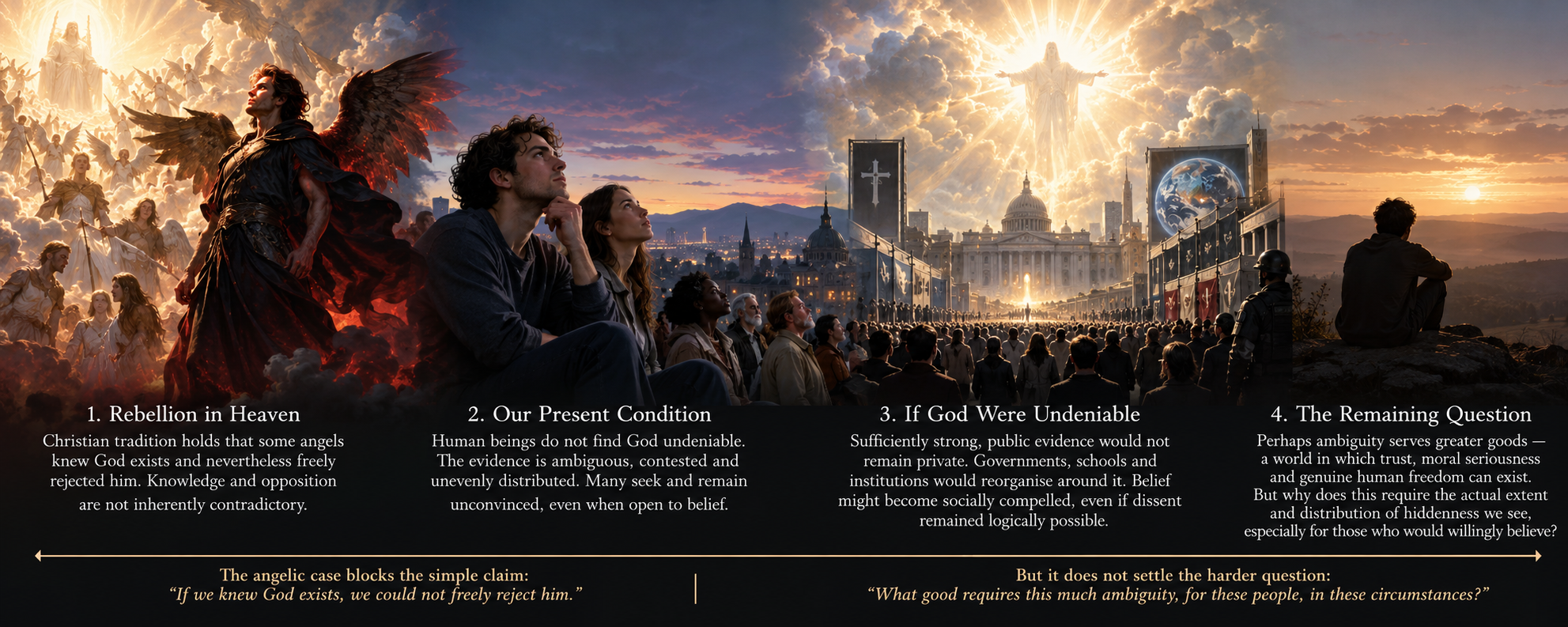
Christian tradition contains a peculiar theological figure: the creature who knows that God exists and nevertheless refuses him.
The Devil of developed Christian theology is not an atheist. Nor, on the traditional account, is his rebellion caused by uncertainty about the supernatural. Satan belongs to the supernatural order. He knows that God exists, knows something of God's authority, and nevertheless turns against him.
This has an obvious bearing on one proposed explanation of divine hiddenness.
A familiar Christian response to the question "Why does God not make his existence clearer?" is that overwhelming evidence would endanger human freedom. God supposedly maintains an "epistemic distance" sufficient to permit faith, trust and love without making rejection psychologically or socially impossible.
At first sight, the rebellion of the angels appears to provide a striking counterexample. Christian tradition itself depicts creatures possessing far greater knowledge of God than human beings while nevertheless exercising their wills against him.
But the argument requires more care than that.
Angels are not simply humans with wings. Classical Christian theology attributes to them a different mode of cognition, a different relation between intellect and will, and, in some accounts, an irrevocability of choice that has no straightforward human counterpart. The tradition therefore cannot simply be transferred from heaven to Earth as though it were an experiment performed on another sample of the same species.
The angelic rebellion does not prove that maximal divine disclosure would leave human freedom untouched. It undermines the simpler inference from certainty of God's existence to the absence of meaningful freedom.
A rebellion the Bible never quite narrates
The conventional story is familiar. Lucifer was originally a magnificent angel. Pride led him to challenge God. Other angels joined him. War broke out in heaven. Michael and the faithful angels defeated the rebels, who were cast down. Lucifer became Satan and the rebels became demons.
That narrative is so thoroughly embedded in Western Christianity that it is easily mistaken for a continuous biblical story. It is not.
Genesis does not narrate Satan's fall. The serpent of Genesis 3 is introduced as a creature of unusual cunning. The text does not identify it as Satan, explain the Devil's origin or describe a celestial rebellion preceding the human Fall.
The Satan of Job is also rather different from the later Christian Devil. Ha-satan appears among the heavenly beings and operates with divine permission. He functions more naturally as an accuser or adversarial member of the heavenly court than as the ruler of an independent kingdom of evil.
The familiar rebellion narrative emerged gradually from several traditions that were eventually read together.
The Watchers
One important strand arose from Genesis 6:1-4, with its mysterious "sons of God", human women and Nephilim. Later Jewish literature expanded those few verses dramatically. In the Book of the Watchers, now preserved within 1 Enoch, heavenly beings descend to Earth, take human wives, teach forbidden arts and contribute to the corruption that precedes the Flood.
Here we have unmistakable angelic transgression, but not yet the later story of Lucifer's proud attempt to overthrow God. The Watchers rebel through illicit involvement with humanity. The later Satanic rebellion has a different centre of gravity: pride, status, self-exaltation and refusal of divine order.
Isaiah's fallen morning star
Isaiah 14 contributed another major component. The prophet mocks the downfall of an arrogant ruler with the famous language, "How art thou fallen from heaven, O Lucifer, son of the morning!" The figure seeks to ascend into heaven, raise his throne above the stars and become like the Most High.
In its immediate context, however, the passage is a taunt against the king of Babylon. "Lucifer", from the Latin lucifer, means "light-bearer" or morning star. It was not originally presented as the Devil's personal name.
Ezekiel 28 performed a similar service. Its lament over the king of Tyre employs extraordinary imagery involving Eden, precious stones, a cherubic figure and expulsion from the mountain of God. Christian interpreters increasingly read behind the human king a description of Satan's primordial condition and fall.
Poetry concerning earthly arrogance became cosmological history.
Satan refuses Adam
A much more explicit rebellion narrative appears in the Life of Adam and Eve. There Satan explains his hostility towards humanity. After Adam is created in God's image, Michael commands the angels to honour him. Satan refuses because he considers Adam inferior and younger than himself. Other angels join his refusal. Satan is consequently expelled from heaven and thereafter seeks Adam's ruin.
This tradition contributes several features that later become familiar: Satan's pride, his refusal of divine hierarchy, the participation of subordinate angels, his expulsion and his hostility towards humanity.
Here the important philosophical feature is already present. Satan's difficulty is not lack of evidence that God exists. The dispute concerns obedience and status.
War in heaven
Revelation 12 supplies the most famous canonical image: "There was war in heaven: Michael and his angels fought against the dragon." The dragon is identified as the Devil and Satan and is cast down with his angels.
It would be tempting to treat this as the missing biblical account of Satan's original fall. But Revelation 12 is apocalyptic symbolism, and early interpreters did not uniformly understand the heavenly war as a primeval event preceding human history.
The traditional rebellion should therefore not be treated as though Revelation independently records a simple historical episode. What matters for the present argument is that Christian theology eventually adopted and systematised such a rebellion, drawing upon a constellation of texts and traditions.
Augustine, Aquinas and the angelic choice
Once theologians accepted that angels had fallen, they had to explain how creatures created good by God could become evil. The answer increasingly turned on free will.
Augustine treated the fallen angels as beings who freely turned from the higher good towards themselves. Pride was not a defect God implanted within them; it was a disordering of a created will.
Aquinas developed the problem with considerably greater precision. Angels possess free will because they are intellectual creatures, yet their cognition differs fundamentally from ours. Human beings reason discursively and reconsider alternatives over time; angelic intellect, on Aquinas's account, does not operate through the same process of inquiry.
Aquinas also distinguishes the angels before and after their decisive orientation towards God. Before beatitude, an angel can turn away through free choice. Once the blessed angel beholds God in the beatific vision, however, sin becomes impossible because God is apprehended as goodness itself. Conversely, the fallen angel's will becomes fixed in evil.
That is a serious disanalogy. The classical account is not merely a story in which God provides clearer evidence to another species and observes the result.
What the angelic case can - and cannot - show
The over-simple argument runs like this: Satan knew God existed; Satan freely rejected God; therefore human beings could know God exists with certainty and still reject him freely.
The conclusion does not follow without additional premises. Human psychology might respond to divine disclosure differently from angelic intellect. Human beings are embodied, socially dependent, emotionally vulnerable and susceptible to fear, conformity and authority.
Moreover, "knowledge of God" is ambiguous. An angel's natural knowledge of its creator, the beatific vision and a human being possessing overwhelming public evidence that God exists are not interchangeable epistemic states.
So the angelic rebellion is not a decisive demonstration that maximal revelation would leave ordinary human freedom unchanged.
But neither is it irrelevant. It establishes, within the Christian conceptual scheme, that knowledge of divine reality and voluntary opposition to divine authority are not inherently contradictory.
It blocks the crude claim that if we knew God existed, we could not freely reject him. It does not block the more serious claim that the evidence sufficient to remove widespread nonresistant nonbelief might itself create psychological and social conditions hostile to the kind of freedom God values.
Logical freedom and practical freedom
A person may remain logically capable of saying no while being placed under pressure so overwhelming that the resulting choice is hardly free in any morally significant sense.
A robber who says "your money or your life" leaves his victim with alternatives in the logical sense. That does not make the transaction voluntary.
Likewise, an unmistakably present, omnipotent God could conceivably exert enormous psychological pressure. If every human being constantly experienced God's presence, knew eternal consequences with certainty and lived in a society equally certain of divine authority, disbelief might disappear while dissent became crushingly costly.
The question is therefore not merely whether a human could still say no. It is whether the conditions under which the human said yes or no would preserve the kind of agency God is supposed to value.
The social problem is not an afterthought
Nor can divine disclosure be treated as a private transaction between God and isolated individuals. Human beings form institutions.
If God's existence became a stable, independently verifiable public fact, law, politics, education, family life and social status could reorganise themselves around it.
Suppose there were repeated, publicly testable divine interventions, reliable predictive revelations or cross-cultural manifestations that survived controlled investigation. If those phenomena were strong enough to eliminate reasonable nonresistant nonbelief across cultures, they would not remain curiosities available only to especially receptive individuals. They would become public knowledge.
Governments would respond to them. Schools would teach them. Religious institutions would claim authority from them. Political movements would seek to legislate in their light. Parents would make decisions for their children on the assumption that the supernatural order had been empirically established.
The problem is therefore not solved merely by observing that evidence admits of degrees. A degree of evidence sufficient to transform the epistemic position of individuals may also transform the social environment in which those individuals choose.
The defender of hiddenness can reasonably argue that there may be no stable culture-wide midpoint at which divine reality is sufficiently clear to eliminate nonresistant nonbelief yet sufficiently contestable to prevent deep institutional consequences.
The institutional coupling problem
This produces what might be called an institutional coupling problem. Evidence that is publicly strong tends not to remain existentially private.
If predictive revelation repeatedly worked, it would eventually become part of the evidential background of civilisation. If prayer produced independently replicable effects, medicine, science and government would investigate them. If supernatural agents appeared under controlled conditions across different cultures, international institutions would concern themselves with them.
The evidential and social dimensions cannot simply be tuned independently. The more successfully God eliminated reasonable doubt through stable public evidence, the more likely that evidence would become embedded in social power.
So the critic cannot simply say that God could provide decisive public evidence while leaving society basically as it is. Perhaps he could. But that requires an argument.
Individual disclosure does not escape easily either
One might retreat from public evidence and suggest that God could reveal himself privately to receptive individuals. That avoids some institutional consequences, but it introduces another difficulty.
If the experiences are private enough to leave public institutions unaffected, their evidential force becomes harder to distinguish from precisely the religious experiences already reported across incompatible traditions. And if God supplies private manifestations with such consistency that all sincere seekers receive them, the regularity itself eventually becomes a public phenomenon.
The tension is real: evidence strong enough to eliminate nonresistant nonbelief must somehow reach the nonresistant; evidence regular enough to do that on a large scale risks generating public patterns; public patterns generate institutions; institutions generate pressure.
A greater-good defence
Perhaps ambiguity is not merely an unfortunate side effect required to preserve the bare capacity to reject God. Perhaps some degree of religious ambiguity is itself part of the good of a human world.
A Christian defender might argue that human beings inhabit a moral environment in which courage, compassion, intellectual seriousness and interpersonal responsibility develop without the constant presence of a universally acknowledged divine evaluator. History remains genuinely human rather than becoming an extension of visibly divine administration. Moral disagreement must be negotiated rather than settled by pointing towards an empirically established supernatural authority. Religious trust remains distinguishable from ordinary perception.
On such a view, divine hiddenness is not simply a technical solution to a free-will puzzle. It contributes to a particular kind of moral and historical environment.
That is a considerably more formidable defence.
"Trust is not sight"
Christian theology already contains resources for such an argument. Faith is often treated not merely as provisional belief pending better evidence, but as a distinctive mode of relationship. "Blessed are they that have not seen, and yet have believed" expresses one version of the thought. So does Paul's contrast between walking "by faith, not by sight".
The critic cannot simply reply that omniscience would allow God to calibrate the evidence more finely. Of course it would. But the question is not whether God could produce another evidential arrangement. The question is whether some good might give God reason not to.
Omnipotence tells us what God can do. It does not, by itself, tell us what kind of epistemic environment divine purposes would favour.
Where the greater-good defence must do more work
Recognising that possibility does not settle the matter. Once the argument moves in this direction, it acquires an explanatory burden. It must account not merely for uncertainty in general, but for the actual pattern of uncertainty.
Religious ambiguity is not evenly distributed. Some people report overwhelming religious experiences; others report none. Some are raised in cultures where belief is socially effortless; others encounter mutually incompatible religious systems. Some people seek God intensely and remain unconvinced. Others become believers with little apparent struggle. Some lose faith reluctantly, despite wanting Christianity to be true.
A greater-good account therefore needs to explain why the relevant goods require not merely epistemic distance in the abstract, but something like the distribution of evidence we actually observe.
Nonresistant nonbelief revisited
Consider someone who is willing to believe in God, would welcome a relationship with God, has investigated sincerely and nevertheless remains unconvinced.
The argument must now say something like this: providing the kind of evidence that would reliably prevent such nonbelief, not merely in this one individual but as part of a stable divine policy, would create psychological, social or historical conditions that undermine goods sufficiently important to justify the nonbelief.
That is possible. But it is a substantial claim. It requires explaining why the good secured by ambiguity justifies allowing a receptive person to fail even to identify the other party to the proposed relationship.
The problem is no longer a simple contradiction between hiddenness and love. It is a problem of proportionality.
What good is secured? How much hiddenness does it require? Why must that good be purchased at this particular epistemic cost?
The cost of a culture-wide solution
The critic should also concede something important. There may be no divine policy that simultaneously guarantees that every receptive person possesses sufficient evidence, that the evidence remains publicly checkable, that religious error is readily correctable, that governments cannot appropriate the evidence, that churches cannot monopolise it, that parents cannot enforce it, that dissent carries little social cost, and that human culture remains recognisably independent of acknowledged divine government.
Those goals may genuinely conflict. A world of embodied, political, institution-building animals is not merely a collection of isolated subjects. Evidence has consequences.
But possibility is not yet explanation
The original position was that clear knowledge of God would destroy freedom. That is too strong.
The revised position is that clear public knowledge of God might generate forms of psychological and institutional pressure that threaten particular goods associated with human freedom, moral development and historical independence. That is plausible.
The further position is that the actual degree and distribution of divine hiddenness are justified because no less costly evidential arrangement could preserve those goods. That is much harder.
The angelic rebellion does not refute it. Neither does the mere existence of nonresistant nonbelief. But the claim requires defence.
The beatific vision objection
Classical theology introduces one further complication. For Aquinas, seeing God "through His essence" is unlike merely possessing conclusive evidence that a proposition is true. In beatitude, God is apprehended as the supreme and unqualified Good, and the will therefore cannot turn away.
If that account is correct, maximal knowledge of God can indeed eliminate one kind of freedom. But the relevant distinction is no longer between belief and disbelief. It is between ordinary propositional or experiential knowledge that God exists and the beatific apprehension of God as Goodness itself.
Aquinas therefore does not establish that clear evidence for God's existence would by itself destroy freedom. He establishes that one particular kind of ultimate apprehension of God transforms the will.
Rebellion without Milton
Nothing here requires Satan literally to have stood upon a celestial battlefield delivering Miltonic speeches while artillery thundered across heaven. The developed rebellion narrative is historically composite.
But that does not make the later theological tradition irrelevant. Christian thinkers themselves used the fall of the angels to explore the possibility of rational creatures freely rejecting God.
The philosophical point is not that the event happened exactly as later Christian imagination depicts it. It is that Christian theology recognises that knowledge of divine reality and willing opposition to divine authority are conceptually separable.
What the rebellion tradition actually establishes
The rebellion tradition therefore supports propositions of different strengths.
- Mere belief that God exists is not identical with love or obedience.
- Creaturely knowledge of God can coexist, under at least some theological models, with morally significant opposition to God.
- It is uncertain whether human beings could possess strong public evidence of God without that evidence significantly altering the social conditions of religious choice.
- It is weaker still to assume that God could eliminate all nonresistant nonbelief while preserving every other good that a world of religious ambiguity is supposed to secure.
The first two place genuine pressure on simplistic freedom defences. The latter two cannot simply be assumed by the critic.
The argument after the easy argument dies
The rebellion in heaven therefore does less than a polemical use of it might suggest. It does not prove that God could make himself unmistakably known to every human being while leaving human freedom, psychology and society untouched.
What it does is remove one easy answer.
Knowledge is not, by itself, the opposite of freedom.
Once that is granted, the debate becomes more interesting. The defender of hiddenness must appeal not simply to the possibility of refusal, but to the quality of the moral, social and historical environment in which refusal occurs. The critic, in turn, must do more than imagine additional evidence. The critic must ask whether the goods allegedly secured by ambiguity really require the amount, distribution and persistence of nonbelief we find.
Conclusion: the price of ambiguity
The Christian tradition of rebellion in heaven emerged gradually rather than from a single biblical narrative. It combined traditions of rebellious heavenly beings, readings of Isaiah and Ezekiel, Jewish stories concerning Satan and Adam, Christian interpretations of Revelation, and later theological reflection on pride, freedom and evil.
Its relevance to divine hiddenness is correspondingly limited but real.
The tradition does not show that human beings would respond to divine certainty as angels supposedly did. It does not show that public certainty could be introduced without transforming institutions. It does not show that God has no reason to value a world in which religious truth remains mediated and contestable.
But it makes one important point difficult to avoid: knowing that God exists and deciding how to respond to God are not the same thing.
That forces a freedom-based account of hiddenness into its stronger form. The serious defence is no longer that God must hide because knowledge would make rebellion impossible. It is that the kind of disclosure required to prevent nonresistant nonbelief may, for embodied and institution-building creatures like us, carry psychological and social consequences that would damage other goods God has reason to preserve.
That defence is coherent. It may even be powerful.
But what good requires not merely some ambiguity, but this much ambiguity, distributed in this way, even among people who would willingly respond if they knew there were someone there to respond to?
The rebellion in heaven does not answer that question. Its contribution is to prevent us from answering a different, easier one.
Loading this essay’s discussion…