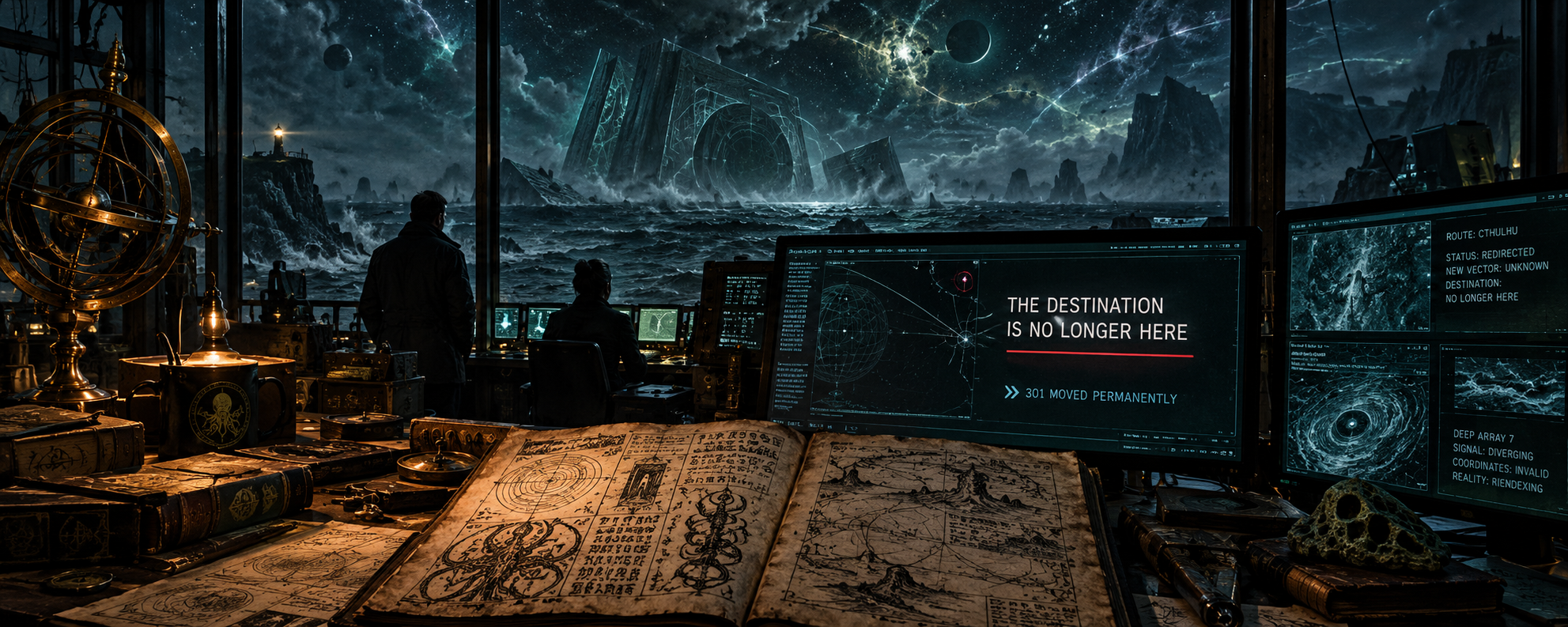
By the time I understood what the error message meant, the Pacific had already moved.
Not the water. That would have been comprehensible.
The Pacific itself.
At 03:11 UTC, three commercial navigation systems placed Point Nemo seventy-three kilometres east of its surveyed position. At 03:13, two astronomical observatories reported discrepancies in stellar parallax which were individually trivial and collectively impossible. At 03:16, the International Earth Rotation Service issued an automated notice and withdrew it forty-two seconds later.
At 03:17, every machine in the room displayed the same sentence.
No programme had generated it.
No network connection remained.
And in the corner, where Professor Wycliffe had spent twenty-seven years assembling fragments of a language nobody had spoken for perhaps ten thousand, the ink on the vellum began to move.
I had joined the project because they needed someone who understood obsolete systems.
This should have warned me.
Wycliffe called it the R'lyeh Manuscript, although no manuscript by that name existed in any catalogue.
It was not a book. It was a reconstruction.
The oldest fragment was a fired clay tablet from the Syrian coast, provisionally dated to the late Bronze Age. Another appeared in a Greek magical papyrus of doubtful provenance. There were quotations in a tenth-century Syriac commentary, a diagram in the notebook of an Elizabethan astrologer, and several passages in a privately printed translation made in Boston in 1926 by a man who disappeared shortly afterwards.
Wycliffe believed they all descended from one source.
He was not, despite appearances, a fool.
He had spent most of his professional life studying ritual texts, and he possessed the useful scholarly vice of assuming that every extraordinary claim had first to survive contact with grammar.
I met him at a symposium in Cambridge.
"You work with legacy systems," he said.
"I used to."
"How legacy?"
"I once maintained software whose original documentation referred to punched cards."
He smiled.
"Excellent. You may be the only man in England qualified to read this."
He pushed a photograph across the table.
It showed a grid of symbols.
I looked at it for perhaps twenty seconds.
"That's not text."
"No?"
"It's structured."
"So is text."
"Not like this."
There were repeated groups, delimiters, what looked like nested sequences and recurring blocks whose positions changed while their internal order did not.
I took out a pen.
"If I had to guess, this part's an identifier. This part looks like a destination. And these may be conditions."
Wycliffe stared at me.
"Conditions for what?"
"I haven't the faintest idea."
That was how it began.
The others called themselves the Congregation of the Sunken Threshold.
They were, to my disappointment, neither robed nor especially sinister.
There were nine of them. An anaesthetist from Bristol. Two academics. A surveyor. A retired naval officer. A software developer from Reading. A woman who restored medieval church paintings. A quiet young man called Peter whose occupation I never discovered. And Wycliffe.
They did not sacrifice goats.
They kept minutes.
The Congregation had existed in one form or another since 1891 and regarded theatrical occultism with approximately the same contempt that physicists reserve for crystal healing.
Their purpose was singular.
They intended to reproduce what they called the Opening.
"Summon Cthulhu," I said.
Wycliffe winced.
"That is a vulgar description."
"But accurate?"
"We don't know."
"You've spent thirty years deciphering a ritual to summon something without knowing what it does?"
"We know what the texts say it does."
"Which is?"
He looked at me over his spectacles.
"It establishes contact."
That answer should have been worse than it sounded.
I spent eleven months on the fragments.
Once I stopped trying to interpret them linguistically, patterns emerged.
The so-called invocations contained repeated numerical groups that Wycliffe's predecessors had treated as sacred numbers. They were not sacred. They were coordinates.
Or something analogous to coordinates.
The distinction mattered.
A latitude and longitude describe a position on a surface. These sequences described relationships between positions that could not coexist in ordinary geometry.
I tried representing them as vectors. That failed.
Matrices were better.
Tensor notation got closer.
Eventually I produced a model in which one could move between points without traversing the distance separating them, provided one accepted that "point", "distance" and "between" were being used rather generously.
Wycliffe was delighted.
I was irritated.
"This doesn't prove anything supernatural."
"I didn't say it did."
"It may simply be an elaborate mathematical game."
"Written in the Bronze Age?"
"People have been clever for quite a long time."
He smiled.
"One of the reasons I like you."
The central sequence appeared in every version of the text.
Wycliffe translated it:
He waits beyond the gate.
I disagreed.
The verb was doing too much work.
In the oldest fragment it appeared elsewhere beside what seemed to be changes in location. In the Syriac copy it accompanied a diagram connecting three circles. In the Elizabethan notebook it was written next to a sequence crossed out and replaced.
I suggested:
The destination persists beyond the passage.
Wycliffe thought that ugly.
It was.
It was also closer.
The Opening required a conjunction that occurred at irregular intervals.
Not because the stars possessed mystical influence, but because the geometry depended on relative position. The ritual instructions were, in effect, waiting for the network topology to become favourable.
I did not use that phrase in front of the Congregation.
Not initially.
The appointed night was 24 October.
We assembled in a converted coastal monitoring station in Cornwall, chosen because it possessed independent power, a clear horizon and enough reinforced concrete to indulge eccentric academics without alarming the neighbours.
The ritual equipment was mostly modern.
Atomic clock.
Three magnetometers.
Two software-defined radios.
A gravimeter borrowed under circumstances Wycliffe refused to explain.
Four computers isolated from external networks.
The only conventionally occult object was the reconstructed text itself, placed beneath glass at the centre of the room.
At 02:40, the Congregation began reciting.
The sounds were unpleasant but not dramatic. No thunder. No green flames. No tentacles against the windows.
At 02:52, one magnetometer registered a fluctuation.
At 02:55, the atomic clock disagreed with itself.
That is not poetic language.
It produced two timestamps for the same event.
I assumed hardware failure and began checking logs.
At 03:02, the gravimeter showed a transient variation too large to be geological and too small to be interesting to anyone who had not spent the previous year translating impossible mathematics.
At 03:06, all four computers recorded an identical numerical sequence.
It matched the destination field in the Bronze Age tablet.
Wycliffe whispered something.
"What?"
"R'lyeh."
"You don't know that."
"No."
For once, he sounded frightened.
The Congregation continued.
At 03:09, the sequence changed.
One digit.
Then another.
Then fourteen simultaneously.
The destination was being rewritten.
I stared at the screen.
"Stop."
Nobody heard me.
"Stop the bloody ritual."
Wycliffe turned.
"Why?"
"Because something is changing the address."
That stopped them.
Not the process.
Only them.
The computers continued updating.
At 03:11, the Pacific moved.
At 03:17, the sentence appeared.
I looked at the vellum.
The reconstructed text had been written in archival ink six months earlier.
The letters were changing.
Not vanishing. Rearranging.
Wycliffe removed the glass with shaking hands.
He read the central line.
"What does it say?"
He did not answer.
"What does it say?"
His lips moved.
"The place appointed has been made other."
I looked at the screen.
"That's a redirect."
Nobody understood.
I pointed at the changing sequence.
"We didn't fail to reach it. We reached something that told us to go somewhere else."
The naval officer, Harris, gave me the look one reserves for civilians who have become excitable.
"Somewhere else where?"
"I don't know."
"Can you find out?"
That was the second question which should have warned me.
We repeated the procedure without the vocal component.
The machines still responded.
That ended the argument about whether the words themselves mattered.
They didn't.
The ritual had never been a spell.
It was a protocol.
The chanting, gestures, incense and all the accumulated ceremonial debris were mnemonic scaffolding built by cultures that understood effects without understanding mechanism.
We had mistaken an interface for a religion.
The Congregation took this badly.
Wycliffe took it beautifully.
"Do you realise what this means?"
"That generations of occultists have been doing technical support by candlelight?"
He ignored me.
"The texts preserve an operational system."
"A badly documented one."
"Older than recorded civilisation."
"Most legacy systems feel that way."
He laughed.
It was the last time I heard him laugh.
The redirect pointed to another sequence.
That sequence redirected to another.
Then another.
We began tracing them.
The chain extended backwards through the manuscript tradition.
A Roman-era copy contained one destination.
The Phoenician fragment contained another.
A pattern carved into a Neolithic stone chamber in Malta, previously classified as decorative, contained a third.
Each destination superseded the last.
Wycliffe assembled the chronology.
I mapped the structure.
The result resembled nothing so much as routing history.
Someone had moved Cthulhu repeatedly.
That was when we began using the name without irony.
Not because we had proved Lovecraft correct in any straightforward sense. We had no evidence of a giant anthropoid creature sleeping beneath the Pacific.
What we had was worse.
We had evidence that something corresponding to the referent of the name had a persistent address in a system older than humanity.
And someone had been altering that address for thousands of years.
"Containment," Harris said.
"Possibly."
"They were keeping it away from us."
I looked at the sequence.
"No."
He frowned.
"What?"
"Look at the direction."
He did.
Wycliffe understood first.
"Oh."
The routes did not point from Earth towards Cthulhu.
They pointed from Cthulhu towards Earth.
The redirects were not preventing us from reaching it.
They were preventing it from reaching us.
That discovery produced two schools of thought.
The Congregation found it encouraging.
I did not.
"If someone has spent geological time diverting the thing," I said, "the relevant question isn't whether the system works."
"What is?"
"Whether anyone is still maintaining it."
Silence.
We returned to the oldest fragments.
The redirect entries contained another field.
I had noticed it months before and assumed it was astronomical.
It was temporal.
An expiry condition.
The dates were difficult to translate because the system did not measure time in terrestrial units. But once we had enough entries, the intervals became clear.
Each redirect had been renewed.
Sometimes after centuries.
Sometimes after millennia.
The most recent renewal corresponded approximately to 8114 BC.
I ran the conversion again.
Then again.
Wycliffe watched my face.
"When?"
I didn't answer.
"When does it expire?"
"Tonight."
At 22:00, we disconnected every external network.
At 22:15, Harris suggested destroying the manuscript.
I asked whether he thought burning a printout would alter the internet.
He did not appreciate the analogy.
At 23:40, the first discrepancies appeared.
A GPS receiver placed us six metres west of ourselves.
At midnight, it was nineteen metres.
At 00:32, a commercial star catalogue updated automatically despite the network being physically disconnected.
Three stars had new positions.
At 01:05, the coastline displayed on an offline mapping system changed.
There was an island west of Chile.
No such island existed.
Wycliffe stared at it.
"I know that shape."
So did I.
We had seen it in the Elizabethan diagram.
The coordinates labelled it with the same sequence the Congregation had spent a century calling R'lyeh.
At 01:47, the island disappeared.
Not from the screen.
From our memory.
For perhaps ten seconds I could remember that there had been something I had forgotten.
Then even that was gone.
I know this only because I wrote it down.
The notebook remains.
I do not remember writing the sentence.
At 02:20, Peter began crying.
He insisted his mother had had three children.
Then two.
Then he could no longer remember why he was upset.
At 02:41, the atomic clock produced seventeen mutually incompatible times.
At 02:55, Wycliffe said:
"It isn't coming closer."
"What?"
"We've been assuming the changes are effects of approach."
He pointed at the manuscript.
"They're corrections."
That was when I finally understood.
Reality was not being damaged.
It was being reconciled.
For billions of years, some part of the universe had been operating under an exception.
A route had been forced away from its natural destination.
The surrounding structure had accommodated that exception.
Now the exception was expiring.
The world was not collapsing.
It was being returned to specification.
I thought of ancient cities built around rivers that later changed course. Roads that preserved vanished property boundaries. Software carrying functions required only because something written forty years earlier expected them.
Human history itself might be full of such accommodations.
Myths.
Geometries.
Dreams.
Religions.
Perhaps consciousness.
Perhaps us.
Temporary dependencies of a redirect nobody remembered creating.
At 03:11, the Pacific moved again.
At 03:13, the stars altered.
At 03:16, every machine in the room shut down.
At 03:17, one came back.
It had no power.
The monitor displayed a single line.
Harris prayed.
The Congregation did not object.
Wycliffe stood beside me.
"So this is it."
"I think so."
"Cthulhu comes."
I looked at the route table one final time.
Something was wrong.
Not mathematically.
Conceptually.
The destination field had changed, but the source had not.
For the entire history of the system, we had assumed that Earth was what the redirects protected.
I traced the oldest surviving route.
Then the next.
Then the next.
I felt a sensation I had experienced only twice in forty years of systems work.
The quiet horror of discovering that the entire architecture has been misunderstood.
"Wycliffe."
He looked at me.
"Earth isn't the destination."
"I know. Cthulhu is."
"No."
I turned the screen towards him.
"Earth is the redirect."
He stared.
I showed him the original path.
The one beneath all the substitutions.
The route Cthulhu had been attempting to follow before something diverted it here.
Not away from Earth.
To Earth.
Again and again.
For at least three billion years.
Wycliffe sat down.
"Why?"
There are moments when the human mind attempts kindness towards itself.
Mine suggested quarantine.
Perhaps Earth was empty when the diversion began. A harmless backwater. A convenient sink.
Then life appeared.
Then complex life.
Then intelligence.
Nothing changed.
The redirect remained.
Whatever maintained the system either had not noticed us or did not consider us relevant.
An entire biosphere had developed inside an error-handling mechanism.
Harris whispered:
"What was the original destination?"
I translated the final sequence.
It was not a location I could map.
It lay outside every geometrical frame we had reconstructed.
But beside it was an annotation.
Wycliffe had translated the corresponding phrase months earlier.
At the time it had seemed ceremonial.
THAT WHICH MUST NOT BE REACHED.
Nobody spoke.
The implication settled over the room with almost physical weight.
For aeons, something had considered Earth disposable.
Not because Cthulhu was dangerous to us.
Because we were safer to lose than whatever lay at the end of the original route.
At 03:19, the sequence stabilised.
The final destination was restored.
There was no thunder.
No monstrous form rising from the sea.
No scream from the heavens.
The stars simply ceased changing.
The Pacific returned to where we remembered it belonging.
Peter remembered having two siblings.
Perhaps he always had.
Perhaps not.
The manuscript became still.
Wycliffe leaned over it.
A new line had appeared beneath the oldest text.
He translated slowly.
"The route is corrected."
Harris asked the question none of us wanted answered.
"What happens now?"
I looked at the destination.
For the first time in perhaps three billion years, Cthulhu was going where he had always intended to go.
I thought of the phrase preserved by frightened scribes who could not possibly have understood what they copied.
THAT WHICH MUST NOT BE REACHED.
And suddenly the existence of Cthulhu seemed almost reassuring.
Because something had once looked at whatever lay beyond him, calculated the consequences, and decided that feeding it Earth was the safer option.
At 03:21, the last machine displayed a second message.
This one required no translation.
DESTINATION ACCEPTED.
And somewhere very far from Earth, something answered.
◆
▶ Watch The Redirection of Cthulhu video
Themes: cosmic horror, Cthulhu Mythos, routing, legacy systems, ritual, non-human infrastructure, anthropocentrism, metaphysical bureaucracy.