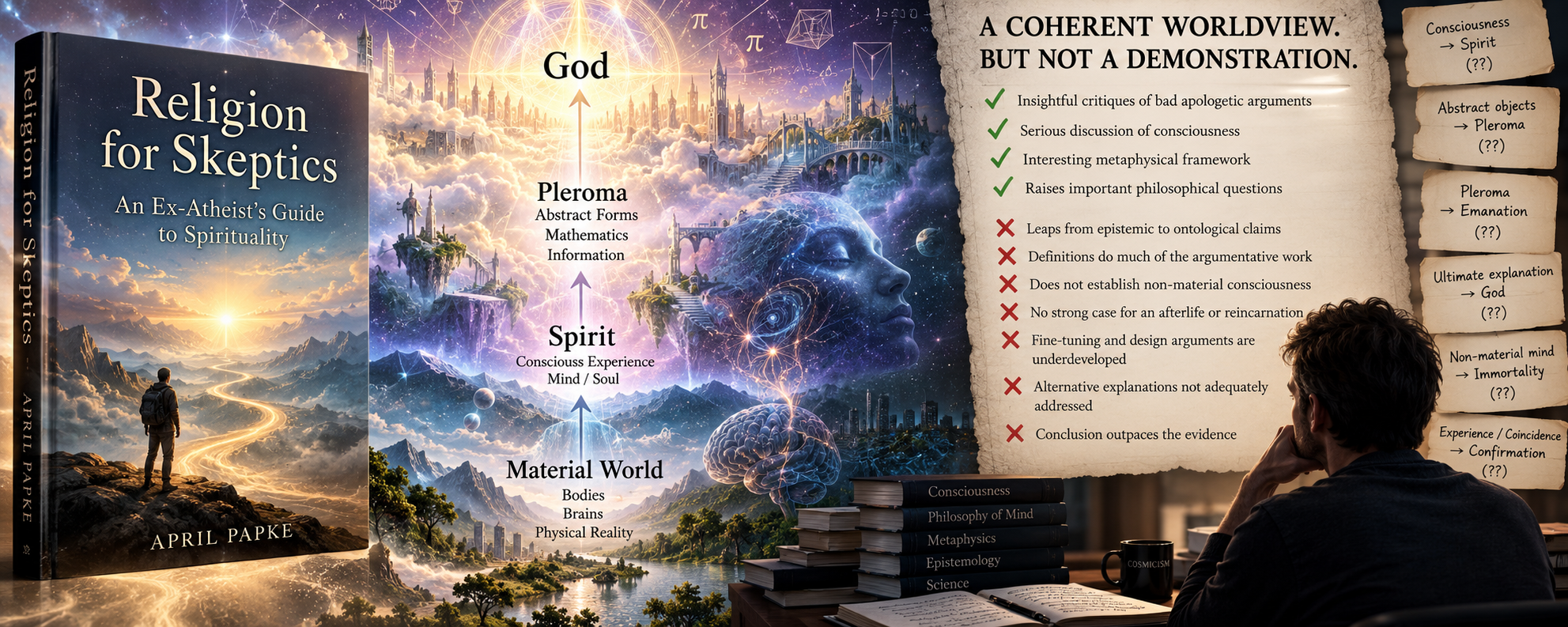
I should probably begin by saying that April Papke's Religion for Skeptics is rather better than its title initially led me to expect.
That may sound like praise delivered through clenched teeth, but it isn't. The book - really something closer to a philosophical monograph than a conventional work of popular apologetics - is not another dreary procession of Kalam cosmology, irreducible complexity, objective morality and quotations from C. S. Lewis, hastily assembled in the hope that sheer numerical superiority will eventually overwhelm the unbeliever.
Indeed, Papke is often quite good at explaining why some of those arguments are bad.
She recognises that Pascal's Wager is not an argument for the existence of God. She understands that "clever people are atheists" is an appeal to authority. She knows that complexity by itself does not establish design, and that the familiar omnipotence paradox involving a stone God cannot lift is mostly a linguistic muddle. She even notices something which a surprisingly large portion of popular apologetics never quite grasps: an argument may look overwhelmingly persuasive from inside a worldview precisely because the worldview silently supplies the premises missing from the argument.
Unfortunately, this last observation applies with remarkable force to Papke's own book.
What she has constructed is not really a proof of theism. It is a metaphysical system into which certain familiar facts - consciousness, mathematics, information, contingency, religious experience and the apparent intelligibility of the world - can be fitted rather neatly.
The system is interesting. It is occasionally ingenious. It contains recognisable elements of Platonism, Neoplatonism, idealism, Gnosticism and classical theism.
What it does not do, in my view, is demonstrate that anybody not already attracted to that metaphysical architecture ought to accept it.
And therein lies the problem.
The sergeant-major method
The first fifth or so of the book is largely preparatory.
Papke spends a considerable amount of time telling the sceptical reader that evidence is coming, explaining why the sceptical reader has probably misunderstood religion, explaining why atheism is often founded upon unexamined assumptions, defining the vocabulary in which the evidence will eventually be presented, and warning that resistance to the argument may itself result from entrenched habits of thought.
It reminded me, perhaps unfairly, of the traditional sergeant-major's instructional method:
The difficulty is not merely stylistic. The preparation gradually fixes the terms of the later argument.
"Atheism" becomes associated with "secular materialism". Secular materialism is then treated as something close to reductive physicalism. Reductive physicalism is subsequently characterised as a kind of faith. And once that chain has been established, objections to Papke's spiritual conclusions can be presented as symptoms of a worldview which has already prejudged the matter.
But atheism, materialism, naturalism, physicalism and scientism are not synonyms.
An atheist can be a Platonist about mathematics. An atheist can reject reductive physicalism. An atheist can take consciousness to pose an unsolved philosophical problem. An atheist can be a moral realist. One can even be an idealist without believing in God.
That matters because a surprising amount of Papke's case depends upon defeating a fairly narrow philosophical opponent and then treating the result as though atheism itself had been defeated.
It has not.
The genuinely interesting part: consciousness
Papke is at her strongest when she turns to consciousness.
She notices, quite correctly, that describing a brain from the third-person perspective does not seem to capture what it is like to be the subject whose brain is being described.
I can examine neural activity associated with another person seeing red. I can identify retinal activity, visual processing, cortical activation and behavioural responses. What I cannot do is literally occupy that person's first-person perspective and experience their redness.
This is not trivial. It is one version of the explanatory problem surrounding phenomenal consciousness, and anyone who thinks neuroscience has already disposed of it has not been paying attention.
Papke calls this the "I problem".
Why am I this subject? Why is there a first-person point of view associated with this body? Why is there something it is like to be me at all?
These are perfectly respectable questions.
The trouble begins when an epistemological distinction becomes an ontological one.
Papke's reasoning repeatedly approaches something like this: I can observe neurons. I cannot observe your subjective experience in the same way. Therefore neurons and subjective experience are fundamentally different kinds of things. Therefore subjective experience is not material. Therefore it is spiritual.
The third step simply does not follow from the second.
My toothache is directly accessible only to me. That tells us something important about access to the state. It does not tell us what the state is made of.
Nor does the fact that two descriptions are radically different prove that two substances are involved. Lightning did not cease to be electrical discharge because "a flash across the sky" and "a rapid electrostatic discharge between differently charged regions" sound like very different descriptions. Water did not become ontologically dual because wetness and H2O appear at different explanatory levels.
Papke knows, and frequently reminds us, that correlation is not causation. Quite so. But she frequently uses that observation as though its converse were: "Correlation therefore indicates no causal dependence." It does not.
The extraordinarily close relationship between alterations of brain state and alterations of consciousness remains a fact any proposed dualism must explain. Anaesthesia, stroke, dementia, intoxication, electrical stimulation, lesions, oxygen deprivation and sleep can radically change or extinguish consciousness.
None of that logically proves reductive physicalism. But neither can it simply be brushed aside by saying that the brain and soul "correlate".
The spiritual rabbit enters the hat
Papke eventually proposes three kinds of existence.
There is the material: particles, bodies, planets, brains and so forth.
There is the abstract: numbers, mathematics, concepts and information.
And there is the spiritual: private phenomenal consciousness, the inward first-person reality of experience.
This is the decisive move in the book. It is also, I think, where most of what follows is quietly determined.
Nobody disputes that phenomenal consciousness exists. The interesting question is what follows from that fact.
Papke labels it "spiritual". Very well. Words are cheap.
I could call phenomenal consciousness "flurble" and immediately prove that flurble things exist.
The substantive question is whether the phenomenon possesses the properties traditionally implied by "spiritual": non-physicality, independence from the brain, persistence after bodily death, perhaps participation in some wider immaterial realm.
Those things do not follow from the label.
Yet as the book progresses, "spiritual" accumulates these properties almost without our noticing.
First, consciousness is private. Then it is non-material. Then it is not caused by the brain. Then it is independent of the brain. Then it cannot be destroyed by bodily death. Then it becomes evidence for an afterlife.
Each transition requires an argument. The word "spirit" cannot perform all of them by itself.
Dream trees and other furniture
Papke offers several thought experiments intended to reinforce the distinction.
One concerns dreams. I may dream about a tree. The tree has apparent colour, extension and location, yet there is plainly no miniature oak tree growing somewhere behind my frontal lobe. Therefore, Papke suggests, the experienced tree belongs to the realm of qualia or spirit rather than the material brain.
But nobody seriously proposes that dreaming about a tree requires a physical tree inside one's skull.
A representation of X is not itself an X. A map of France does not contain France. A computer rendering of Saturn does not require a tiny Saturn inside the graphics card. A brain can represent a tree without containing a tree.
The thought experiment therefore establishes something everyone already knew - representational content is not identical to the object represented - while appearing to establish something much larger.
The same problem occurs with duplicates and clones.
Papke invokes variations on Swampman and perfect physical duplication. Suppose an atom-for-atom duplicate of me existed elsewhere. It would have my memories and dispositions but would not be this conscious subject.
Quite right. But why is that a problem for physicalism?
Two identical computers remain two computers. Two identical books remain two books. Two physically identical brains occupying different locations and possessing different causal histories are numerically distinct physical systems.
Physicalism does not predict that they should share one consciousness.
The confusion here is between qualitative identity and numerical identity. Two entities may be exactly alike without being the same entity. No soul is required to explain the distinction.
The curious case of the hylic
One of the more peculiar passages introduces the old Gnostic distinction between "hylic" and "pneumatic" people.
Papke suggests that some individuals may simply fail to grasp the "I problem" or the inward character of spiritual existence. She compares this possibility with aphantasia: someone incapable of visual imagery may have genuine difficulty understanding what another person means by "seeing" an image in the mind.
The analogy is intriguing. It is also epistemically dangerous.
If I recognise the spiritual phenomenon Papke describes, that supports her account. If I fail to recognise it, perhaps I am hylic. If I find the argument incoherent, this may itself indicate my inability to grasp the relevant mode of existence.
One has thereby constructed a rather efficient self-sealing system.
Disagreement can no longer straightforwardly count against the hypothesis because the hypothesis contains an explanation for disagreement. This is generally a warning sign.
Aphantasia earns its place as a psychological hypothesis because we can study it independently, compare reports, make predictions and investigate cognitive and neurological differences. "Some people cannot perceive their spiritual nature" requires the same sort of independent support. It cannot simply be invoked when sceptics remain sceptical.
Information, mathematics and the ascent to the Pleroma
The second major strand of Papke's argument concerns abstract entities.
She is correct that information cannot simply be identified with one physical medium. The same novel can be printed on paper, stored magnetically, encoded optically or remembered by a person. Destroying one copy does not destroy the abstract structure represented by every other copy.
But from this she repeatedly approaches the conclusion that information therefore exists independently of matter.
That is a much stronger claim.
A melody may be played on a piano, violin or kazoo. That does not establish an immaterial melody-substance floating beyond all possible performances.
Similarly, Papke treats numbers as genuinely existing abstract objects. Two apples, two stones and two galaxies all instantiate "two"; the written symbol "2" is not itself the number.
That is a respectable form of mathematical Platonism. It is also one side of a very old philosophical dispute.
Nominalism, fictionalism, structuralism and other accounts of mathematical objects have not vanished merely because Platonism is intuitive.
Papke is entitled to argue for Platonism. What she cannot reasonably do is use Platonism as though it were an established observation and then build subsequent metaphysics upon it.
Eventually this realm of abstract forms becomes the Pleroma: an effectively infinite landscape of mathematical structures, concepts, forms and possibilities.
From there she adopts a broadly emanationist picture: abstract reality gives rise to spiritual reality; spiritual reality gives rise to material reality; and these layers ultimately require some fundamental source.
This begins to look much less like a discovery forced upon us by physics or consciousness and much more like what it plainly is: a Neoplatonic-Gnostic metaphysical architecture.
There is nothing wrong with that. But calling an architecture "the inevitable conclusion of sceptical reasoning" does not make it so.
Finally, God
Eventually we arrive at a chapter cheerfully entitled "Finally, God".
By this stage the route has been prepared.
If reality consists of successive emanations, Papke asks us to consider the ultimate source from which these emanations derive. She calls that source God.
Again, one needs to watch the definitions.
If "God" means "whatever is metaphysically fundamental", then proving that something is metaphysically fundamental would indeed prove that "God" exists under that definition.
But it would not yet establish a deity in the interesting sense.
Does this foundation think? Does it intend? Does it possess agency? Does it know? Does it choose? Does it care? Is it even a being rather than a necessary structure, law or brute fact?
Those questions cannot be answered merely by attaching the word "God" to the explanatory terminus.
Papke nevertheless proceeds towards omniscience and omnipotence by arguing, roughly, that because everything derives from the ultimate source, all knowledge and power ultimately derive from it.
But being the metaphysical source of information does not entail possessing conscious knowledge. The laws governing an eclipse do not themselves know the eclipse will occur.
Likewise, being foundational does not automatically produce agency. A necessary mathematical structure might underlie reality without intending anything at all.
Fine-tuning and false alternatives
Papke also discusses fine-tuning, presenting something like a choice between "derived necessity" and "arbitrary selection".
Either the constants of nature follow necessarily from some deeper mathematical structure, or they were selected. If selected, presumably there is a selector. If necessary, the necessity itself supposedly points towards Papke's ultimate metaphysical foundation.
The logical landscape is considerably larger than that.
The constants might be brute facts. They may emerge from a deeper theory. They may vary across a multiverse. Their apparent contingency may reflect our ignorance of deeper constraints. They may result from some selection effect with no mind involved. They may be explicable by a theory nobody has yet formulated.
"Could have been otherwise" does not mean "was deliberately chosen". Nor does "must be thus" mean "therefore God".
A necessary physical structure would be a necessary physical structure. To turn it into a mind requires another argument.
The same difficulty appears when Papke presents consciousness as forcing a choice between intelligent design and divine intervention.
Either, she suggests, the laws of nature were set up from the beginning to produce spiritual beings, or something intervened when spiritual beings appeared.
There is an obvious third option: the laws of nature permit sufficiently organised systems to become conscious.
Papke believes she has already excluded this. I do not think she has. The dilemma therefore inherits the failure of the earlier argument.
Death without dying
The afterlife section is where the accumulation of assumptions becomes particularly conspicuous.
Papke reasons that if the soul is not material and is not caused by the brain, bodily death need not affect it.
Quite so - if those premises have been demonstrated.
They have not.
Even granting that consciousness cannot be reduced to a simple inventory of particles does not establish that consciousness can continue without the organisation producing it.
Non-reducibility does not imply independent persistence.
A wave is not identical to any one water molecule, but that does not make the wave immortal when the sea becomes still.
Papke also invokes eternalist interpretations of relativity, suggesting that past and future events are in some sense equally part of spacetime.
But even if one accepts a block universe, nothing about it implies that a conscious worldline extends indefinitely.
A railway line can exist from Cambridge to London without continuing to Aberdeen. Likewise, all events along a finite life may belong to spacetime without there being events beyond the death of the organism.
Relativity does not provide immortality.
Reincarnation: at last, something empirical
Papke's discussion of reported past-life memories is actually one of the few places where the book gestures towards evidence which could, in principle, alter my view.
She refers to children who apparently remember details of deceased people: names, occupations, circumstances of death and other information which is subsequently confirmed.
Such claims should not be dismissed merely because they sound strange. If genuinely anomalous information is being acquired under well-controlled conditions, that would be interesting.
But the evidential ladder must still be climbed carefully.
One would first need to exclude information leakage, parental prompting, selective reporting, retrospective fitting, cryptomnesia, coincidence, interviewer effects, fraud and publication bias.
If those were genuinely excluded, we might have evidence for anomalous information transfer. We would still need a further argument to establish reincarnation rather than some other unknown process.
And then a further philosophical argument concerning personal identity. Having memories associated with a deceased person is not automatically identical with being that person.
The point is not to explain away the phenomenon in advance. It is to avoid turning "unexplained" into "therefore my preferred explanation".
Papke repeatedly accuses materialists of doing precisely that in the opposite direction. The standard ought to apply both ways.
Evil, demiurges and explanatory bookkeeping
Papke's Gnostic commitments become especially useful when confronting the problem of evil.
Moral evil is partly attributed to conflicting wills. Natural suffering is more difficult.
Her response allows the material world to be the work of an ignorant or imperfect demiurge rather than the direct creation of the ultimate God.
That is certainly one way of insulating the supreme deity from the horrors of the world.
But it does so by adding another supernatural entity.
One has not so much solved the explanatory problem as opened another account in the metaphysical ledger.
The ordinary evidential problem of evil concerns the tension between an omnipotent, omniscient, perfectly good creator and the quantity and distribution of apparently gratuitous suffering.
If one denies that the ultimate God created this world directly, the tension is reduced. But the price is substantial: we now require evidence for a demiurge, a hierarchy of emanations and the relationship between them.
A metaphysical system can explain almost anything if enough entities and intermediate principles are available. The question is why we should believe those entities exist.
Where Papke is right
It would be unfair to treat the book merely as a catalogue of mistakes.
Papke makes several points worth retaining.
She is right that atheists can become intellectually complacent. She is right that shouting "science!" is not a substitute for philosophy. She is right that questions about consciousness, ontology and mathematical truth cannot simply be dissolved by pointing at a laboratory. She is right that religious experiences deserve investigation rather than automatic ridicule.
She is right that "one less God" is a slogan rather than a serious argument. She is right that Pascal's Wager does not establish belief. She is right that many religious people inherit beliefs first and construct arguments afterwards. And, although she gives less attention to the symmetrical point, secular people can certainly do the same.
She is also right about something more important: worldviews frequently operate beneath conscious argument. We inherit categories, assumptions and standards of explanation which can make alternative views look absurd before they have been properly understood.
A good sceptic ought to know that.
The irony is that Papke's own system eventually becomes similarly protected by its vocabulary.
"Materialist" becomes someone demanding the wrong kind of explanation. "Hylic" becomes someone who may lack the relevant inward apprehension. "Spirit" becomes consciousness interpreted through dualism. "Pleroma" becomes Platonism expanded into cosmic ontology. "God" becomes the ultimate explanatory source.
Once the words are accepted in Papke's senses, the metaphysics begins to look almost inevitable.
But what has become inevitable is the language.
Reality has not necessarily followed it.
Faith after argument
Towards the end, Papke distinguishes blind faith from earned trust.
She compares religious faith to a trust fall: one becomes confident through experience, repetition and accumulated reasons.
There is nothing inherently objectionable about that.
But once a person has adopted a religious interpretation, ordinary events can begin appearing evidentially loaded.
Coincidences become guidance. Intuitions become prompting. Fortunate timing becomes providence. Meditative depth becomes spiritual contact. Anomalous experiences become glimpses behind the material veil.
Perhaps some are.
But this is precisely the point at which scepticism should become more rigorous rather than less.
Human beings are magnificent pattern-recognition machines and rather poor spontaneous statisticians. We remember the extraordinary coincidence and forget the thousand non-events surrounding it. We reconstruct memory. We notice meaningful hits. We overlook misses.
None of that proves there is no providence. It means providence must be demonstrated by evidence capable of distinguishing it from the perfectly ordinary human tendency to see significance.
What has actually been shown?
By the end of the book, Papke believes she has taken the sceptical reader along a cumulative path:
consciousness exists - therefore spirit exists;
abstract reality exists - therefore the Pleroma exists;
material and spiritual reality emanate from that deeper abstract reality - therefore there is an ultimate source;
that source is God;
spirit is independent of matter - therefore death does not destroy it;
hence afterlife and perhaps reincarnation;
and religious experience subsequently supplies experiential confirmation.
The difficulty lies in the arrows.
Phenomenal consciousness to spirit requires the claim that first-person privacy entails ontological non-physicality.
Abstract objects to Pleroma requires a strong Platonism which is treated rather more as observation than philosophical commitment.
Pleroma to emanation requires a theory of ontological dependence which has not been independently demonstrated.
Ultimate explanation to God requires showing that the explanatory terminus is a mind rather than merely a foundation.
Foundation to omniscience and omnipotence requires treating sourcehood as though it entailed agency and cognition.
Non-material consciousness to immortality requires independence from the physical brain.
And anomalous experience to spiritual confirmation requires excluding ordinary psychological and informational explanations rather more carefully than the book usually attempts.
Papke has supplied a narrative connecting these claims.
She has not, in my view, supplied the necessary entailments.
The real achievement
So what is Religion for Skeptics?
It is not a successful demonstration of God.
Nor is it nonsense.
That latter judgement would be much too easy and, more importantly, wrong.
It is a serious attempt to reconstruct religious belief from first principles by beginning with consciousness and moving outward through an idealist and Platonic metaphysics.
Its closest relatives are not really modern evangelical apologetics at all. They are Gnosticism, Neoplatonism, idealism and the long philosophical tradition which regards ordinary material appearance as a secondary manifestation of a more fundamental order.
Read in that spirit, the book becomes considerably more interesting.
Papke is essentially saying: perhaps we have mistaken the map of physical science for the whole territory. Perhaps consciousness is fundamental. Perhaps abstract structure is more ontologically serious than modern materialism ordinarily allows. Perhaps what religion has historically called "spirit" and "God" are imperfect attempts to describe these deeper layers.
I do not find that conclusion absurd.
I find it underdetermined.
The same observations support several competing philosophical interpretations.
That is the point at which Papke repeatedly moves from "here is one coherent interpretation" to "here is what scepticism ultimately reveals".
And that final step is precisely what she has not earned.
An unexplained feature of consciousness becomes spirit. An unresolved question about abstract objects becomes the Pleroma. A demand for ultimate explanation becomes God. A problem of personal identity becomes evidence of an immaterial self. The possibility that materialism is incomplete becomes evidence that materialism is false.
These are not trivial mistakes, because almost everything else depends upon them.
Yet neither do they make the book worthless.
There is something rather admirable about someone attempting to build the entire structure rather than simply pointing to a sunset and declaring that atheism has been refuted.
Papke has at least understood that if one wishes to move a sceptic, one must address ontology, epistemology, consciousness and evidence.
The result is simply much less conclusive than she believes.
From my own cosmicist perspective, the most interesting possibility is one Papke never seriously entertains.
Perhaps consciousness really is strange. Perhaps mathematics really does reveal something profound about the structure of reality. Perhaps our ordinary categories of matter, mind and information are inadequate. Perhaps there are aspects of existence which human cognition will never fully comprehend.
None of that implies that the universe has intentions.
Still less does it imply that it cares.
One can stand before the explanatory abyss without filling it with a personality.
Indeed, that is rather the point.
The universe may be considerably stranger than materialism in its crudest form supposes, while remaining entirely indifferent to us.
There are more things in heaven and earth than are dreamt of in our philosophies.
But "more things" is not synonymous with God.
And mystery, however profound, is not evidence of providence.
That distinction is where Papke's monograph finally leaves me: not persuaded by its theology, but rather more interested in the metaphysical problems it raises than I was in the answers it proposes.
Which is, perhaps, not an entirely negligible achievement.
Book discussed
- April Papke, Religion for Skeptics: An Ex-Atheist's Guide to Spirituality. Kindle edition consulted.
Loading this essay's discussion...