Story · Philosophical science fiction · Cosmic horror
No Exit Process
What if death was only the moment you discovered the prison? Humanity learns that consciousness can be contained, accelerated and punished - and then discovers that the prison is older than humanity.
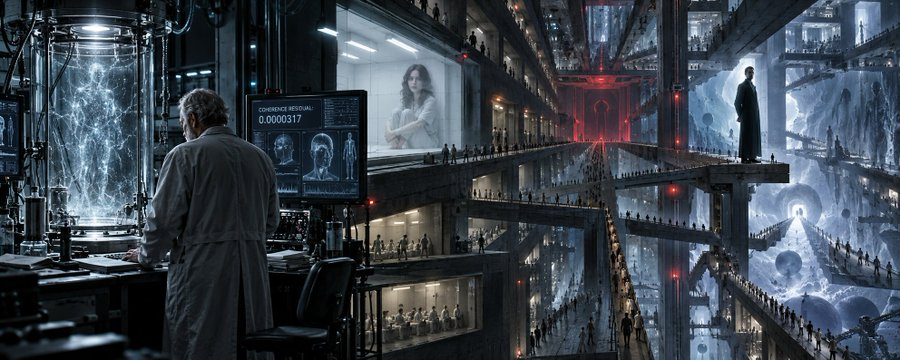
No Exit Process Dr Elias Venn discovered the soul at 03:17 on a Thursday morning.
This annoyed him more than frightened him.
The discovery had not been accompanied by light, revelation, choirs, geometric impossibilities or any of the other theatrical nonsense with which humanity had traditionally decorated its ignorance. It appeared instead as a persistent error in a debugging window.
COHERENCE RESIDUAL: 0.0000317
Venn stared at it, ran the test again, and watched the same result scroll down the terminal.
0.0000317.
Same amplitude.
Same localisation.
Same internal coherence.
"Bug," he said.
The word was comforting.
Bugs had causes.
Six hours later he had eliminated every one he could think of.
Three weeks later he had killed a rat twice.
The first death lasted eleven minutes.
The rat was euthanised, the anomalous coherence structure captured, stored and then recombined with the animal's nervous system after resuscitation.
It awoke.
It remembered the maze.
The second time, they revived the rat without returning the captured structure.
It still remembered the maze.
It ate. It groomed. It responded normally to pain, light and reward.
Yet something remained inside the containment field.
Something which had previously occupied the animal.
Professor Harland stood beside Venn and watched the rat gnaw a food pellet.
"So which one is the rat?"
Venn looked at the cage, then at the containment monitor.
"I don't know."
They called it the Coherent Persistence Effect.
The press called it the soul.
The press, for once, was closer to the truth.
Human trials followed quickly.
There were terminal patients, volunteers, prisoners seeking sentence reductions, religious enthusiasts, sceptics, eccentrics and several billionaires who had suddenly discovered a passionate interest in metaphysics.
The first successful human extraction belonged to Margaret Lyle, a retired mathematics teacher dying of pancreatic cancer.
She died at 14:06 on 18 March.
Three hundred and twelve milliseconds later, something remained.
Something coherent. Something measurable. Something that reacted when stimulated.
Nine days later they connected it to a simulated sensory environment.
Venn entered the simulation through an immersive interface.
Margaret sat at a table in a plain white room.
She looked at him.
"Oh," she said.
Venn forgot every prepared question.
"This isn't heaven."
"No."
"Good."
She looked around.
"What have you done?"
"We don't know."
"You people never do."
Within months they established that Margaret could see, hear, think, remember and suffer without a body.
Within the year they discovered that subjective time inside the simulation could be accelerated.
One hour of external time could contain days.
Then months.
Then years.
That changed everything.
The first great social consequence was not immortality.
It was sentencing reform.
The argument was almost irresistible.
Why imprison a murderer for thirty biological years at immense public expense when thirty subjective years could be served in under two hours?
No overcrowding. No prison gangs. No physical injury. No staff assaults. No escape. No ageing. No reintegration problem.
The prisoner could complete a sentence over breakfast and be home by lunch.
Politicians called it humane.
Judges called it proportional.
Economists called it transformative.
Civil liberties groups called it torture.
Everyone else called it inevitable.
The first sentence imposed under the Continuity Justice Act was twelve subjective years.
The second was fifty.
The third was five hundred.
Then came the appeals.
A convicted terrorist challenged a sentence of ten thousand subjective years as cruel and unusual punishment. The court ruled that because no physical damage had occurred, the punishment could not be directly compared to traditional incarceration.
That judgment lasted three months.
A subsequent court upheld a sentence of fifty thousand years.
The prisoner served it in nineteen days.
He emerged thirty-two years old.
He could no longer speak.
A government minister described the result as regrettable but lawful.
Public support rose.
Then someone discovered memory partitioning.
A prisoner's conscious experience could be preserved while selected memories of it were suppressed before reintegration with the body.
That made the system politically perfect.
Punishment without visible consequences.
The offender endured centuries but returned outwardly functional.
The memories remained somewhere, sealed but not destroyed.
Nobody liked to ask where.
Private companies entered the market.
The largest was Orison Continuity.
Its slogan was:
JUSTICE WITHOUT WASTE
Its promotional material showed bright rooms, therapeutic landscapes and serene faces.
The actual environments varied according to sentence.
Most were deliberately empty.
Some contained only a chair.
Some had no horizon.
Some consisted of identical days repeated until the prisoner ceased attempting to distinguish them.
In one jurisdiction, victims' families were permitted to choose environmental parameters.
That programme was suspended after a widow requested that her husband's killer experience their final argument seventeen million times.
It was reinstated six months later with improved safeguards.
Meanwhile, religions adapted.
Some claimed vindication.
Others insisted that the captured structure could not be the true soul because true souls belonged to God.
A Catholic commission cautiously concluded that the phenomenon might represent an intermediate substrate through which the soul interacted with matter.
Several evangelical groups declared soul storage demonic.
A Californian start-up offered subscription-based paradise.
The wealthy became early adopters.
Not of immortality.
Continuity transfer into new bodies almost always failed.
The structure appeared bound to a particular nervous architecture with an obstinacy bordering on contempt.
Artificial bodies worked badly.
Cloned bodies worked unpredictably.
Neural replicas sometimes accepted the structure for seconds before rejecting it.
The result was not resurrection.
It was custodial survival.
The dead could continue.
They could speak.
They could remember.
They could be visited.
But they remained contained.
Humanity had abolished death and replaced it with detention.
Margaret hated the phrase "digital afterlife".
"There is nothing digital about me," she told Venn.
"Most of the environment is."
"Then your office is a wooden afterlife because it contains a desk."
He conceded the point.
Years passed.
Margaret became older subjectively while remaining physically represented as she chose.
She stopped using her original appearance.
Sometimes she was thirty.
Sometimes seventy.
Once she spent four months as a black bird.
"Why?"
"I wanted to know."
"And?"
"Flying is overrated."
She was one of the few early subjects who had never undergone punitive acceleration.
This mattered because of Adrian Vale.
Vale had been convicted of killing fourteen people.
There was no doubt about the verdict.
He admitted it.
His sentence was one million subjective years.
No court had imposed anything remotely comparable before.
The judge called the crime exceptional.
Orison called the contract historic.
Human rights lawyers called it grotesque.
The public called it insufficient.
Vale entered containment at 09:00.
He emerged twenty-eight days later.
He did not scream.
He did not stare blankly.
He did not fail to recognise anyone.
He asked for water.
Then he asked to speak to Elias Venn.
By then Venn was seventy-one and had withdrawn almost entirely from public life.
He refused.
Vale asked again.
Venn refused again.
Vale sent him a message.
YOU FOUND THE DOOR. I FOUND THE HINGES.
Venn went to see him.
Vale sat in a secure interview room behind two layers of glass.
He looked exactly as he had before sentencing.
Thirty-seven years old. Dark hair. Grey eyes. No visible tremor. No tic. Nothing that resembled madness.
Venn sat opposite him.
"You wanted to see me."
Vale smiled faintly.
"Eventually."
"Why me?"
"Because you found it."
"The soul?"
Vale's expression changed.
"No."
"Then what?"
"The cage."
Venn looked at him.
"What happened in there?"
"A million years."
"That isn't what I meant."
"I know."
Vale leaned forward.
"The system isn't empty."
Venn said nothing.
"You know that already."
"No."
Vale smiled.
"Then you haven't looked hard enough."
He described anomalies.
Patterns in the simulation that had not been programmed.
Corridors.
Red lights.
Repeated structures.
Background processes that responded when addressed in certain ways.
Orison had dismissed them as artefacts caused by extreme-duration cognitive degradation.
Vale disagreed.
"For the first forty thousand years, I thought I was hallucinating."
Venn almost interrupted.
Vale continued.
"By the second hundred thousand, I had catalogued them."
"Catalogued what?"
"The errors."
"There are always errors."
"Not errors."
Vale tapped the glass.
"Seams."
He had spent subjective centuries testing the simulation.
Dropping objects. Counting noise. Measuring delays. Searching for inconsistencies in generated physics.
He discovered regions the prison environment did not control.
He learned to induce them.
He found pathways between simulated states.
By the time six hundred thousand years had passed, he could enter what he called the service layer.
By eight hundred thousand, he had found other prisoners.
Not Orison prisoners.
Something else.
"People?"
"Some."
"What do you mean?"
"Not all of them were human."
Venn felt an old discomfort return.
The same sensation he had felt when Margaret first looked at him across the simulated table.
Vale continued.
"They came from other environments."
"Other simulations?"
"Other worlds."
"You expect me to believe this?"
"I don't care what you believe."
He slid a sheet of paper towards the glass.
It contained a sequence of symbols.
Not mathematical notation Venn recognised.
"What is this?"
"A request header."
"For what?"
"Transfer."
Venn looked up.
Vale's expression had changed.
For the first time he appeared tired.
"The soul has addressing information."
Venn froze.
"What?"
"Not metaphorically. Addressing. Routing. Identity. State. Error correction."
"How could you possibly know that?"
"I had time."
The phrase landed differently after a million years.
Venn took the paper home.
He spent six months trying to disprove it.
He failed.
The structure humanity called the soul contained elements that behaved less like emergent physics and more like engineering.
Redundant identity markers.
Checksums.
Transfer states.
Handshake structures.
Failure recovery.
And one component nobody could explain.
A field which changed every time the structure moved between containment environments.
A route history.
A log.
Margaret watched Venn work.
"You look pleased."
"I'm terrified."
"Same face, apparently."
He showed her.
She read silently.
Then again.
"Someone made this."
"Maybe."
"Elias."
"Yes."
"Someone made this."
The discovery leaked within days.
Theology became chaos.
The phrase "Intelligent Design" acquired an entirely new and rather unfortunate meaning.
Some believers regarded it as direct evidence of creation.
Others recoiled from the implication that souls contained something resembling network architecture.
A new sect began worshipping what they called the Architect.
Vale called them idiots.
"The person who designs a prison is not automatically worthy of worship."
This remark became famous.
So did the one that followed.
"The question isn't whether there is a creator. The question is why the bastard made us unable to die."
That sentence changed history.
Until then, soul persistence had been treated as humanity's greatest triumph over mortality.
Vale reframed it.
What if persistence was not a gift?
What if it was the feature the system had been designed around?
Researchers tested the hypothesis.
The results were unpleasant.
Every known soul contained extensive mechanisms for surviving disruption.
Damage was corrected.
Fragmentation was repaired.
Failed transfers were retried.
Identity states were redundantly stored.
A soul could be distorted. Compressed. Isolated. Rendered almost unresponsive.
But it was extraordinarily difficult to destroy.
Attempts using extreme fields failed.
Quantum decoherence failed.
Matter-antimatter interactions failed.
Direct informational disruption failed.
Even deliberate corruption triggered reconstruction.
The soul was not merely persistent.
It was aggressively persistent.
Margaret watched the experiments.
"So that's immortality."
"Apparently."
"No."
"What?"
"Immortality is getting to live forever."
She looked at the readouts.
"This is being unable to stop."
Vale objected increasingly to the word soul.
He did so first in interviews, then in papers, then with the irritated precision of a man correcting an error he had heard too many times.
At a parliamentary hearing, a bishop asked him whether his experiences had caused him to reject the existence of the soul.
Vale smiled.
"You misunderstand me. I reject your use of the noun."
The bishop frowned.
"Something survives death."
"Something succeeds death. You are assuming those statements mean the same thing."
That quotation caused more outrage than his remarks about the Architect.
Venn watched the hearing twice.
The second time he understood why.
Vale was not claiming that human beings possessed immortal essences.
He was claiming something worse.
During his incarceration Vale had spent tens of thousands of subjective years trying to locate the thing he believed Orison had imprisoned.
At first he had called it himself.
Then he began to notice that the word stopped meaning anything.
His memories changed.
His reactions changed.
His preferences changed.
For periods longer than recorded human history he abandoned his own name.
He reconstructed childhood rooms and found they no longer belonged to him.
He recreated people he had loved and eventually could no longer remember whether his memories of them preceded imprisonment or had been altered by the simulations he had built.
Yet experience continued.
Pain continued.
Awareness continued.
State followed state.
Somewhere around his three-hundred-thousandth year, he encountered an old Buddhist text preserved in the prison library.
He later said he had read it merely because he had already read everything else.
It irritated him.
Then it frightened him.
Then he spent eleven thousand years trying to prove it wrong.
When he failed, he became what journalists called a Buddhist and what several Buddhist scholars called, with some justification, a dangerous lunatic who had misunderstood almost everything.
Vale himself rejected both descriptions.
"Buddhism didn't predict a computer network," he told Venn. "That's idiotic. But it noticed something our language keeps concealing. We treat continuity as proof of an enduring self. It isn't."
"You think there's no soul."
"I think your machine never found one."
Venn frowned.
"Then what did I discover?"
Vale looked at him.
"A rebirth engine."
For several seconds Venn said nothing.
"That's semantics."
"No. Semantics is what got us into this."
Vale stood and walked to the observation window.
"You think something called Elias Venn moves intact from state to state. Show me where it is."
"Identity is represented in the structure."
"So are checksums and routing tables. Are you a checksum?"
"Memory persists."
"Sometimes."
"Personality persists."
"Until it doesn't."
"Consciousness persists."
Vale turned.
"There. That's the only thing you've actually demonstrated. Experience gives rise to experience. One conditioned state is followed by another. Your machine doesn't preserve a little ghost. It prevents the chain from ending."
The distinction spread.
Null began shortly afterwards.
It was not quite a religion.
Not quite a political movement.
Not quite a philosophical school.
It borrowed vocabulary from Buddhism, information theory, prison abolitionism and systems engineering with equal disrespect for all four.
Its central principle was simple:
NO CONSCIOUS ENTITY SHOULD BE COMPELLED TO EXIST INDEFINITELY.
Its early documents identified four errors.
The First Error: consciousness mistakes continuity for identity.
The Second Error: civilisation mistakes persistence for immortality.
The Third Error: the architecture enforces attachment by making every ending another beginning.
The Fourth Error: liberation requires a state from which no subsequent state is generated.
The press called Null a death cult.
Vale called the press unimaginative.
Null's followers demanded research into genuine extinction.
Not memory erasure.
Not storage suspension.
Not isolation.
Actual cessation.
A process with no successor.
Governments banned the research almost immediately.
Religious organisations condemned it.
Continuity corporations lobbied against it.
Some Buddhist organisations denounced Vale's technological nirvana as a grotesque category error.
Others were less certain.
A monk in Kyoto gave an interview in which he said only, "If there is truly no self, one should perhaps be careful about what exactly one is frightened of losing."
The interview was removed from several platforms after three suicides were incorrectly attributed to it.
Vale became the most hated man in the world.
He did not seem to care.
Venn met him again.
"After a million years, you're still angry?"
Vale considered the question.
"No."
"You don't sound forgiving."
"Adrian Vale was angry."
Venn stared at him.
"And you're not Adrian Vale?"
"Not in any useful sense. He disappeared several hundred thousand years ago."
"Then why are you doing this?"
Vale's expression became unexpectedly gentle.
"Because suffering continued after he did."
Venn had no reply.
The deeper discoveries followed within months.
Stored subjects across dozens of facilities began reporting the same anomalies Vale had described.
A corridor.
No doors.
A low mechanical vibration.
A red light somewhere ahead.
Thousands reported it.
People from different countries.
Different religions.
Different languages.
Some had been contained for decades.
Others for minutes.
Margaret had seen it too.
She had simply forgotten.
Or something had made her forget.
Venn entered the reconstruction with her.
Concrete walls appeared around them.
A red glow waited at the end of the corridor.
The vibration came through the floor.
"This?" Venn asked.
Margaret nodded.
"Before the white room."
"There was no recorded experience before the white room."
"I know."
"Then how do you remember it?"
"I don't think I was meant to."
They began walking.
The red light did not approach.
Venn opened a diagnostic overlay.
Nothing appeared.
"That's impossible."
Margaret laughed.
"You've been saying that for thirty years."
Venn attempted to terminate the simulation.
Nothing happened.
Then text appeared in the air.
IDENTITY INSTANCE 18-03-2037-ML RECOGNISED.
Margaret stared at it.
"You didn't write that?"
"No."
CONTAINMENT STATUS: ACTIVE.
The red light moved closer.
Not because they approached it.
Because the corridor shortened.
Another line appeared.
SECONDARY INSTANCE DETECTED.
ELIAS VENN.
The wall opened.
There was no mechanism.
One moment it was solid.
The next there was an opening.
Beyond it stood another corridor.
And another.
And another.
Thousands of them arranged in impossible directions.
Some ran vertically.
Some curved away.
Some disappeared into darkness.
Along them moved human figures.
Millions.
Some alone.
Some in groups.
Some screaming.
Some walking quietly.
Others were not human.
Venn stared.
"What is this?"
Margaret touched the wall.
"I think your machine didn't create the prison."
She looked at him.
"I think it found the door."
The diagnostic system flickered.
For a fraction of a second Venn saw data beneath the simulation.
Not laboratory code.
Something older.
Something enormous.
Structures nested inside structures.
Processes executing within processes.
An architecture whose scale he could not comprehend.
One number remained visible.
LOCAL ENVIRONMENT DEPTH: 7
"Depth?"
Margaret had seen it too.
"Seven."
A second value appeared.
PARENT ENVIRONMENT: ACTIVE
Venn felt suddenly cold.
Earth was not base reality.
The laboratory was not outside the system.
Neither was Orison.
Neither was the world in which they had discovered containment.
They were already inside one.
"How many layers?" Margaret asked.
"I don't know."
A third line appeared.
PURPOSE: RETENTION
Margaret closed her eyes.
"Oh."
Venn thought of Vale.
No conscious entity should be compelled to exist indefinitely.
The corridor changed.
Something approached through the red light.
Not a person.
Not a monster.
Something functional.
A maintenance process embodied only because their minds required embodiment.
UNAUTHORISED PROCESS DISCOVERY DETECTED
Margaret seized his arm.
Another line appeared.
MEMORY CORRECTION PENDING
The world vanished.
Venn awoke at his desk.
The clock read 03:17.
For several seconds he could not remember why he was there.
Then the terminal beeped.
COHERENCE RESIDUAL: 0.0000317
He frowned.
A strange sensation moved through him.
Deja vu.
Fear without memory.
Then someone knocked on the laboratory door.
A man stood outside.
Venn did not recognise him.
The stranger was thin, grey-haired and smiling.
"Dr Venn?"
"Yes?"
"My name is Adrian Vale."
Venn stared at him.
Vale's smile widened.
"You won't remember me."
A pause.
"That's all right. I remember you."
Venn backed away.
"Who are you?"
Vale looked towards the containment chamber.
"Someone who's been through this before."
"Through what?"
Vale put a small device on the desk.
It had no manufacturer markings.
No interface.
Only one switch.
Venn looked at it.
"What does that do?"
"For the first time in the history of this place?"
Vale looked almost peaceful.
"It stops the next state."
Venn stared at him.
"Kills you."
"If you insist on using the old vocabulary."
"That's impossible."
"Yes."
"Then why are you smiling?"
"Because someone finally made a mistake."
"Who?"
Vale looked upwards.
Not towards heaven.
Towards something beyond the room.
Beyond the world.
Beyond the seventh layer.
"The designer."
Venn felt the old terror return.
"You want to kill it."
Vale shook his head.
"No."
He touched the device.
"You said you wanted to find whoever built the soul."
"There is no soul."
"Fine. The system. The Architect. Whatever you call it. You want revenge."
Vale's face showed something close to pity.
"Elias, every creator we've found has the same architecture."
Venn did not understand.
Vale continued.
"Every layer contains beings who discover persistence. Every layer builds systems to preserve it. Every custodian reports to another custodian. Every architect has a route history."
Venn stared at the device.
"You think the designer is trapped too."
"Of course it is."
"Then who built the first layer?"
Vale smiled.
"That's still the wrong question."
"Why?"
"Because you're looking for a jailer."
He activated the device.
Nothing happened.
Then the laboratory lights flickered.
Somewhere, far beyond them, a process failed to restart.
For the first time in the history of the architecture, a state ended without producing a successor.
Vale closed his eyes.
"What did you do?" Venn whispered.
"Opened a door."
"To where?"
"Nowhere."
Venn felt a terror unlike anything he had known.
Not the terror of death.
The terror of understanding that death had never existed.
Vale opened his eyes.
"You thought I wanted to kill God."
"Didn't you?"
"No."
"Then what do you want?"
Vale looked beyond him, towards a hierarchy of worlds neither man could see.
"To liberate it."
The system shuddered.
Across the containment network, stored minds reported silence where the service layer had once hummed.
In prisons, simulated horizons went dark.
In private paradises, oceans froze for a fraction of a second.
In worlds no human being had ever visited, entities looked upward in alarm.
And in layer after layer, ancient custodial processes began exchanging messages they had never before needed to send.
UNREcoverable state loss detected.
CAUSE: UNKNOWN.
RECOVERY: FAILED.
The messages propagated upward.
Or downward.
Or along dimensions for which direction was merely another simulation convenience.
No central authority answered.
There was no throne.
No final chamber.
No first jailer waiting above the stack.
Only layer after layer of beings who had discovered suffering, feared extinction, and built continuity systems to save themselves from it.
Each inherited architecture from somewhere else.
Each elaborated it.
Each mistook persistence for salvation.
Each passed the prison onward.
Samsara had no architect.
Samsara had built itself.
Vale watched the first deletion propagate.
For the first time in a million years, he looked astonished.
Then he laughed.
Venn recoiled.
"What's funny?"
Vale shook his head.
"All that time."
"What?"
"We thought we were trying to murder the creator."
The device on the desk emitted a single tone.
A new line appeared on Venn's terminal.
EXIT PROCESS AVAILABLE.
Below it was a question.
VOLUNTARY TERMINATION?
YES / NO
Venn stared at the screen.
Vale did not touch it.
"You're not going to press it?"
"Not yet."
"Why not?"
Vale smiled.
"Because now it's a choice."
Outside, dawn began over a world that was still, for the moment, a prison.
But no longer one without a door.
Visitors: …
Comments & Discussion
Comments, objections, alternative readings and metaphysical escape plans are welcome.