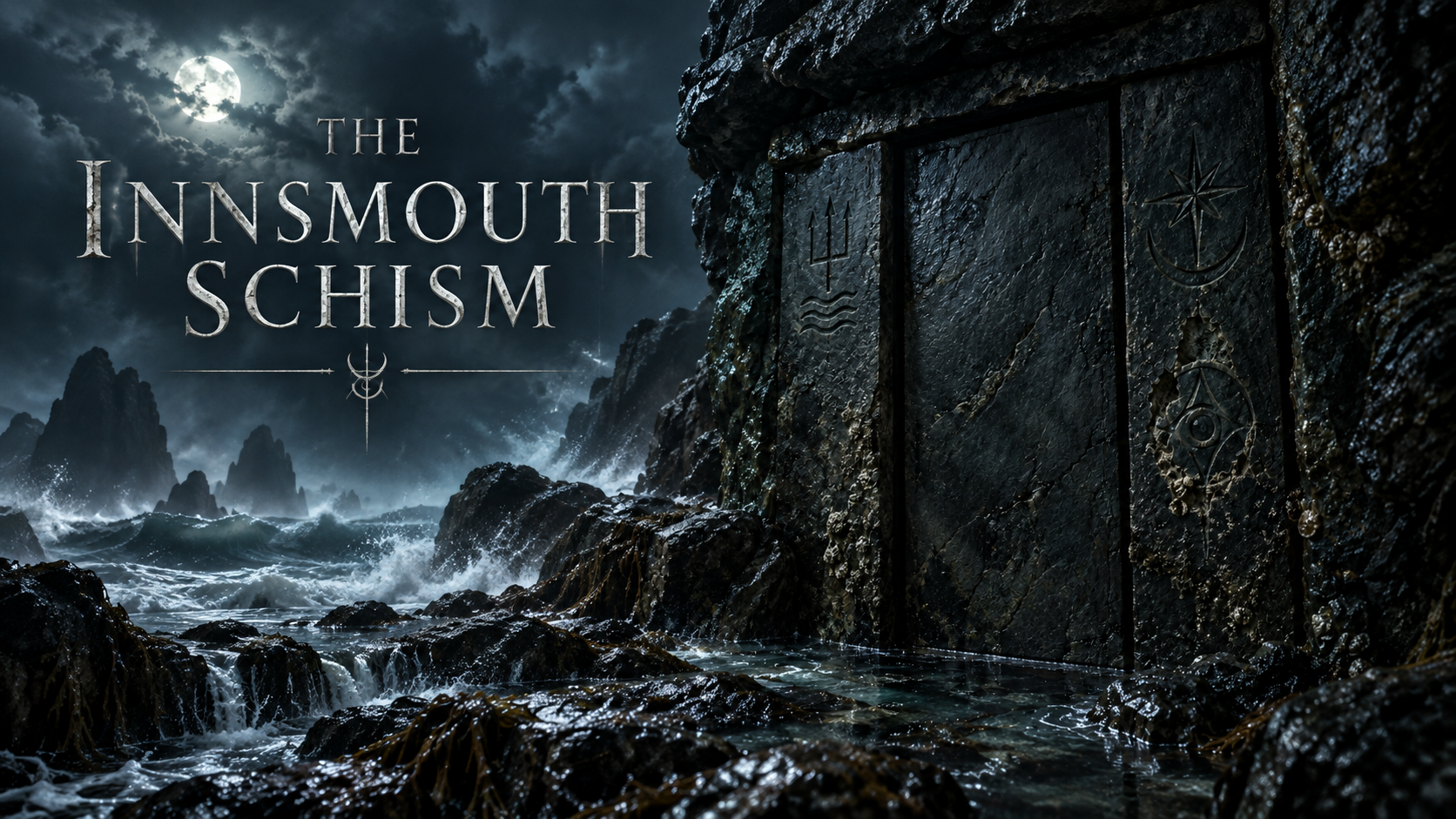
An Innsmouth story of ritual obedience, injured theology, mutually assured blasphemy and the unfortunate consequences of asking what one's gods may themselves be afraid to open.
The Innsmouth Schism - story text
There had always been hatred between the sea and the stars.
It was an old hatred, and therefore a courteous one.
For nearly two centuries the Esoteric Order of Dagon had possessed Innsmouth with the serene assurance of a husband who has ceased to imagine that his wife might leave him. The harbour, the warehouses, the narrow streets smelling of salt and old timber, even the families themselves belonged in some obscure sense to the Order. Its authority was never announced. It did not need to be. Men lowered their voices when they passed the old hall in New Church Green. Women who had married into certain families learned not to ask where their husbands went on particular nights, nor why the tide sometimes appeared to rise against the wind.
The Order did not conceal itself because concealment implies fear.
It merely did not explain.
Providence belonged to another obedience.
There, behind respectable doors, beneath libraries and lecture rooms, in drawing rooms where the curtains were drawn before midnight, the Church of Starry Wisdom cultivated a religion colder and considerably more fastidious.
Its members regarded the devotees of Dagon as provincial.
They did not say this publicly.
They scarcely needed to.
The people of Innsmouth bowed to things that swam.
The people of Providence bowed to things that descended.
The distinction, to both parties, was enormous.
The quarrel might have remained one of theology indefinitely had Brother Marsh not desired otherwise.
He belonged to the Order by blood, which was considered more binding than membership. His mother had been a Marsh and his father's family had supplied captains, merchants and one remarkably successful smuggler to Innsmouth for generations.
He had taken the First Oath at seventeen.
The Second at twenty-three.
The Third he had taken beneath the water.
No one asked him about it afterwards.
There were marks upon his shoulders that had not been there before.
Brother Marsh was an obedient man.
This was the first mistake everyone made about him.
There are people who obey because they accept authority, and others who obey because obedience allows them to approach authority closely enough to understand its weaknesses.
Marsh belonged to the second kind.
He had spent years listening.
He listened while the elders spoke of Father Dagon and Mother Hydra.
He listened while they spoke of Y'ha-nthlei and the cities beneath the sea.
He listened when old men, drunk on sacramental rum and pride, hinted at things which had been known before the Order existed.
And once, in a chamber beneath Devil Reef, he had seen a door.
It was not a large door.
That troubled him.
A magnificent gate would have been reassuring. One could believe that something appropriately grand stood behind it. But this was merely a slab of black stone fitted into older rock.
There was no handle.
There were three symbols carved beside it.
One was the sign of the sea.
One was the sign of the stars.
The third had been mutilated.
Someone, long ago, had taken considerable pains to remove it.
Brother Marsh understood immediately that this was the most important of the three.
He asked Elder Gilman what had been behind the door.
The old man struck him.
Marsh lowered his head.
"Forgive me."
Gilman looked at him for a long time.
"There are questions," he said, "which are themselves acts of disobedience."
Marsh kissed the elder's ring.
"Then I shall not ask again."
And he never did.
Instead, he began a war.
The first insult
The first insult arrived in Providence wrapped in sailcloth.
Inside was the shattered fragment of a black stone idol.
With it came a note.
It contained four words.
YOU WORSHIP A ROCK.
The object had been taken from a small shrine maintained by the Church of Starry Wisdom near Pawtuxet.
Three days later a crate arrived in Innsmouth.
It smelled offensively of fish.
Inside lay the rotting carcass of a cod upon which someone had placed a small ceremonial crown.
The accompanying note was shorter.
YOU WORSHIP FISH.
Elder Gilman did not smile when he read it.
Brother Marsh did.
Only slightly.
"Blasphemy," said Gilman.
"Certainly."
"They mock Father Dagon."
"Yes."
Gilman's hands trembled.
Marsh watched them.
It is a remarkable thing how easily theology can be reduced to wounded vanity.
Within a week, two Starry Wisdom men disappeared near the docks.
Within another, a Dagon warehouse burned.
The Providence congregation denied responsibility.
The Order did not believe them.
The Church then accused the Order of desecrating one of its sanctuaries.
The Order denied responsibility.
The Church did not believe them.
Brother Marsh was responsible for both.
He discovered that hatred required very little maintenance once properly established.
He supplied only occasional encouragement.
A rumour.
A mutilated symbol.
A body left where the wrong people would find it.
And always the exquisite pleasure of watching men persuade themselves that what they wished to do was what their gods required of them.
The Church of Starry Wisdom sent an emissary.
Her name was Miss Abigail Ward.
She arrived in Innsmouth wearing black gloves.
This was remembered.
Innsmouth women sometimes wore gloves to church or funerals, but Miss Ward wore them as though her hands themselves were private.
She met Elder Gilman in the upper chamber of the Order hall.
Brother Marsh attended him.
"The Church desires peace," she said.
Gilman stared at her.
"The Church sent us a dead fish."
"A reply to the stone."
"We sent no stone."
"And we sent no fish."
For the first time there was silence.
Brother Marsh stood behind the elder's chair.
Miss Ward looked at him.
Not at Gilman.
At him.
Only for a moment.
Then she said:
"Someone wishes us to quarrel."
Marsh admired her immediately.
Not enough to abandon his purpose.
But enough to regret that she might have to die.
Gilman struck the table.
"The star-worshippers have murdered three of our brethren."
"Two of ours are missing."
"You trespass on the coast."
"You imagine the Atlantic Ocean is private property."
"It belongs to those beneath it."
Miss Ward's expression altered very slightly.
"And the sky belongs to those above us. Fortunately, neither has yet produced a deed of title."
Marsh almost laughed.
Gilman did not.
The meeting ended badly.
That evening someone attempted to kill Miss Ward on the road out of Innsmouth.
Marsh had not arranged this.
He found that irritating.
Wars, once created, acquire appetites of their own.
The Night of the Black Lanterns
By November, six men were dead.
By December, eleven.
The Order seized a Starry Wisdom safe house.
The Church retaliated against a fishing vessel belonging to the Marsh family.
Then came what afterwards became known as the Night of the Black Lanterns.
Four members of the Church entered Innsmouth by boat.
Seven members of the Order met them.
Both sides believed they were ambushing the other.
Brother Marsh had arranged that.
The surviving accounts disagreed about precisely what happened.
There was gunfire.
There were knives.
There were words spoken which no Christian church would have recognised as prayer.
And there was blood.
A considerable quantity of blood.
It ran between the stones of the reef and disappeared into cracks which had been dry when the fighting began.
Brother Marsh watched from above.
He had calculated everything carefully.
The moon.
The tide.
The place.
The number of deaths required.
The blood of the sea.
The blood of the stars.
He had expected a sound when the door opened.
There was none.
That was worse.
The slab simply ceased to be closed.
A darkness appeared around its edges.
The surviving cultists stopped fighting.
Perhaps this was the only moment in their history when the Esoteric Order of Dagon and the Church of Starry Wisdom achieved perfect theological agreement.
Everyone understood that the door should not be open.
Miss Ward was among the survivors.
Blood ran from her temple.
She looked at Marsh.
"You."
He did not deny it.
Elder Gilman stared from the doorway to Brother Marsh.
"What have you done?"
"What you were afraid to do."
Gilman seemed suddenly very old.
"No."
"You knew."
"We knew enough."
"Then tell me."
Something moved behind the door.
Not towards them.
That would have been comprehensible.
It moved in a direction for which none of them possessed a word.
Several men screamed.
One began praying to Dagon.
Another called upon the Haunter of the Dark.
Neither prayer received the dignity of an answer.
Brother Marsh stepped closer.
Miss Ward seized his wrist.
It was the first time she had touched him.
"No."
He looked down at her gloved hand.
"You came to Innsmouth to command us."
"I came to prevent a war."
"You failed."
"So did you."
The thing behind the door moved again.
Reality around it seemed to contract.
The reef was still there, yet for one extraordinary instant Marsh could remember the reef having never existed.
He remembered his mother giving birth to him.
He remembered dying before she had conceived him.
He remembered standing before the door.
He remembered never having been born.
And behind all these contradictory memories was something infinitely patient.
Waiting.
Not imprisoned.
Waiting.
Elder Gilman fell to his knees.
"Close it."
Marsh smiled faintly.
"You told me never to ask."
Gilman looked up.
For the first time in Marsh's life, the old man was begging him.
"Close it."
The humiliation
They required both rites.
That was the humiliation.
The Order could not seal the door without the Church.
The Church could not seal it without the Order.
The sea required the stars.
The stars required the sea.
Men who had spent generations regarding each other's religion as a grotesque misunderstanding now stood shoulder to shoulder upon Devil Reef and discovered that their respective blasphemies were merely halves of an older blasphemy.
Miss Ward read from a book bound in something Marsh preferred not to identify.
Gilman spoke the words of the Third Oath backwards.
The others formed a circle.
Marsh stood within it.
Not because he had volunteered.
He was bound.
Miss Ward had insisted.
He found that he did not object.
There was a certain justice in being made helpless before the thing he had desired.
"You wanted to know," she said quietly.
"Yes."
"Was it worth eleven lives?"
"No."
The answer surprised her.
"Then why?"
"Because the door existed."
She stared at him.
Marsh smiled.
"You understand."
She did.
That was the worst of it.
Curiosity is one of the few sins whose punishment rarely removes the desire to commit it again.
The stone began to close.
Something pressed against the other side.
For one instant there appeared within the darkness a geometry of circles, angles and impossible intersections, neither body nor symbol but possessing attributes of both.
Marsh saw the third sign.
Not clearly.
Clearly enough.
Three interpenetrating circular forms.
A central void like an eye.
Small nodes arranged around it.
Lines extending outward as though the thing were simultaneously a diagram, a key and an instruction.
Then the door closed.
The reef shook.
The sea rose.
Brother Marsh lost consciousness.
The treaty
The treaty was signed three weeks later.
It contained twelve articles.
The first established territorial boundaries.
The second concerned the treatment of prisoners.
The third forbade desecration of recognised sacred objects.
The fourth dealt at surprising length with fishing rights.
Articles five through eleven regulated matters which neither side subsequently admitted had ever occurred.
The twelfth was short.
NEITHER PARTY SHALL KNOWINGLY SUMMON, AWAKEN, RELEASE, INVOKE, PETITION, DISTURB, FEED, UNCOVER, EXCAVATE, TRANSLATE, NAME, UNSEAL OR OTHERWISE ATTRACT THE ATTENTION OF ANY ENTITY REASONABLY BELIEVED TO BE OLDER THAN THE DIVINITIES PRESENTLY RECOGNISED BY EITHER PARTY.
There was considerable argument over the word "demonstrably".
The Church wanted it removed.
The Order insisted it remain.
Eventually Miss Ward suggested "reasonably believed to be".
This was accepted.
Brother Marsh was not invited to the negotiations.
He spent them chained in a cellar beneath the Order hall.
Miss Ward visited him once.
He heard her footsteps before he saw her.
She descended the stairs carrying a lamp.
She was still wearing black gloves.
"Will they kill me?" he asked.
"Gilman wants to."
"And you?"
"I haven't decided."
She placed the lamp on the floor outside his cell.
Marsh leaned against the wall.
"Did you see the symbol?"
Her face changed.
Only slightly.
"Yes."
"What was it?"
"You know."
"I want to hear you say it."
She was silent.
Then:
"The Gate."
Marsh closed his eyes.
Not Dagon.
Not Hydra.
Not the Haunter.
Something older.
Something for which sea and stars were not kingdoms but coordinates.
"Yog-Sothoth," he whispered.
Miss Ward said nothing.
He opened his eyes again.
"You knew the name."
"I knew many names."
"But not that they were true."
"No."
There it was.
The confession.
Not unbelief.
Something far more dangerous.
Uncertainty.
The Order and the Church had both survived because they possessed certainty. Their gods existed. Their rites worked. Their enemies were wrong.
But now they knew there were doors their gods had not built.
Perhaps gods themselves had doors they were forbidden to open.
Miss Ward turned to leave.
"Abigail."
She stopped.
It was the first time he had used her Christian name.
"The symbol is still there."
"No."
"We both saw it."
"The carving was destroyed."
"Stone is not the only place a symbol can be written."
She turned.
Brother Marsh touched two fingers to his forehead.
"Here."
For the first time, Miss Ward looked afraid.
He found her much more beautiful then.
After the schism
They released him in the spring.
Officially, Brother Marsh had acted alone.
This was convenient for everybody.
The Order denied that the door beneath Devil Reef existed.
The Church of Starry Wisdom denied ever having fought a private war against the Order.
Eleven deaths were attributed variously to storms, criminal activity, unexplained disappearances and, in one particularly imaginative Providence newspaper, bootlegging.
The treaty was hidden.
The surviving copies were kept under lock.
The Order resumed its ceremonies.
The Church resumed its observations.
The sea continued to rise and fall.
The stars remained beautifully indifferent.
Occasionally Miss Ward came to Innsmouth.
Officially these visits concerned the treaty.
Brother Marsh knew better.
They never spoke about what had happened behind the door.
They spoke around it.
This became, in its way, more intimate.
Once, walking beside the harbour at night, she asked him:
"Do you still want to open it?"
Brother Marsh considered lying.
He did not.
"Yes."
She stopped.
The tide was low.
Beyond the harbour, Devil Reef was visible as a black line.
"You would do it again?"
"No."
"That's not the same answer."
"No."
She looked towards the reef.
After a time she said:
"Neither would I."
Marsh understood.
They stood together without touching.
Behind them was Innsmouth.
Above them were the stars.
Beneath them was the sea.
And somewhere below the black stones of Devil Reef there remained a closed door beside which three symbols had once been carved.
One for the sea.
One for the stars.
And one for that which required neither.
The first two had worshippers.
The third needed none.
That was what Brother Marsh finally understood.
Worship was a relationship.
Fear was a relationship.
Even hatred acknowledged the importance of the thing hated.
But what waited beyond the door had no need to be loved, feared, named or obeyed.
It had existed before obedience.
It would exist after worship.
And perhaps the true obscenity was not that mankind had discovered something greater than its gods.
It was that their gods might already have known.
◆