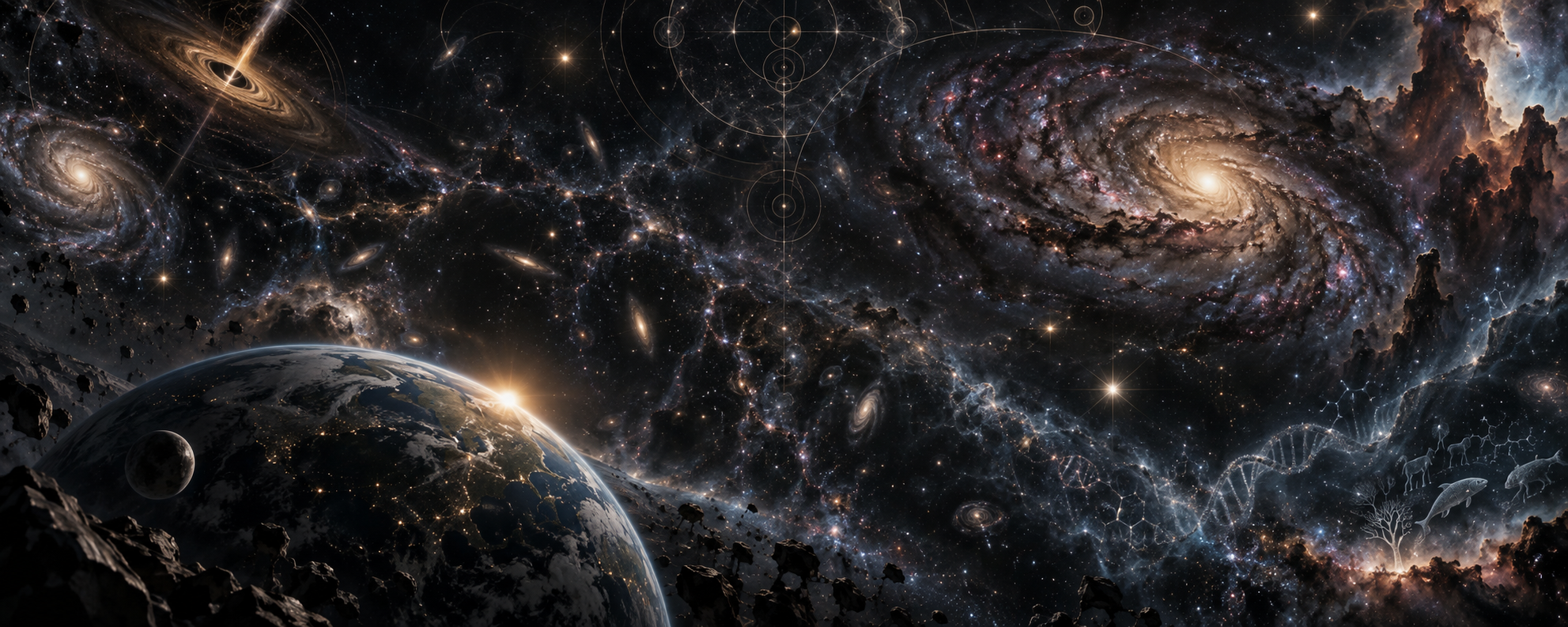
Fine-tuning arguments usually end too early.
The familiar form is straightforward enough. Certain physical constants appear to occupy ranges compatible with stars, chemistry, planets and eventually life. Alter those values sufficiently, and the argument goes, complex structures could never arise. The universe therefore looks improbably suited to life. Perhaps it was designed.
Then, rather abruptly, God enters the room.
But suppose we grant the argument. Suppose the constants were deliberately selected rather than being brute facts, necessary consequences of deeper physics, or one realised configuration among many. Suppose there is intention behind the architecture of the cosmos.
The interesting question then begins.
What kind of intelligence would design this universe?
If an artefact is evidence for an artificer, it is also evidence about the artificer. A bridge may reveal concern for load, cost and durability. A machine may reveal what its maker was prepared to trade for speed, elegance or reliability. We may misread those priorities, but we cannot legitimately infer a designer from the object and then refuse to inspect the object when asking what the designer is like.
Fine-tuning may therefore be allowed its strongest premise. The constants were chosen. Life was intended. Even then, purpose does not by itself establish providence, human centrality, benevolence, revelation or any particular theology.
The evidence we actually have
There are two questions here, and they should not be confused. The first is whether fine-tuning favours some kind of design over impersonal naturalism. That is the usual debate. This essay is concerned mainly with the second: given design, what sort of designer does the designed world suggest?
The relevant evidence is not merely that a life-permitting universe exists. It is the whole observed pattern: life-permitting laws operating across an overwhelmingly lethal volume; immense stretches of time before humanity; biological history shaped by extinction, predation and parasitism; no obvious route in which Homo sapiens is a necessary destination; regular physical processes that do not adjust themselves to moral circumstance; and no public signature by which the maker of the system can be unambiguously identified.
A serious theist need not claim that a good God would create a celestial nursery. A good God might have reason to create finite conscious agents capable of knowledge, agency and relationship, and might prefer a lawful world in which such beings can act, learn and discover consequences. Stable regularity may itself be a good. A world of constant miracle would not obviously be better.
That is the stronger case, and it should be granted.
The pressure comes from what follows. If personal welfare and recognition are central divine aims, should we expect this route: billions of years of cosmic and biological history, mass extinction, pre-human suffering, enormous regions permanently hostile to terrestrial life, and persistent ambiguity about the identity of the maker? If those features are expected, the explanation has substantial work to do. If they are not, then fine-tuning for the possibility of life has not yet delivered the intimate, human-centred God often smuggled in at the end of the argument.
In Bayesian terms, the useful comparison is not simply between "life given God" and "life given no God". Let E stand for the full evidence described above. Then the interesting question is how well E fits different designer profiles: a benevolent creator for whom personal welfare and recognition are central; a remote creator whose aims run towards lawfulness, complexity or emergence; or an inscrutable creator whose priorities cannot safely be translated into human moral categories.
Naturalism remains a live alternative outside this conditional exercise. But once design has been granted, the theology should be constrained by the artefact rather than imported into it.
Law, waste and indirectness
If the universe was designed for the possibility of life, it is still an extraordinarily inhospitable place for living things. Vacuum, radiation, stellar interiors and deep cold are not necessarily gratuitous defects. They may be bound up with the same general physics that permits stars, heavy elements and chemistry. That is precisely the point. Fine-tuning, even if real, is tuning for life to be possible under general laws, not evidence that the cosmos is organised around human convenience or flourishing.
A desert containing a teaspoonful of water may technically contain conditions compatible with fish. One would hesitate to describe the desert as designed for aquaculture.
The analogy has limits. The theist need not have promised an aquarium. But it usefully blocks an illicit inference: from "the system permits life" to "the system is principally for life", still less "principally for us". A world may contain intended organisms while having an objective function quite unlike their comfort.
The same caution applies to time. If the aim were simply to produce human beings, the method is astonishingly indirect. Stars first manufacture the elements. Planets form. Chemistry becomes biology. Biology diversifies through contingent historical processes. Humanity arrives after the orchestra has been playing for most of the evening.
That indirectness is not an objection to design as such. A lawful creator might prefer processes to shortcuts. But it weakens the assumption that this species is the obvious point of the project. Rewind terrestrial evolution and there is no clear reason to expect Homo sapiens to appear again. Intelligence might arise. Consciousness might arise. Something quite unlike us might arise. The route does not advertise our inevitability.
One can read the system as favouring emergence: simple laws generating increasingly elaborate structures, eventually including observers. That is an attractive interpretation, but it must not become a new anthropomorphism. "Complexity", "elegance", "emergence" and even "patience" are human descriptions of what we see. They may be the least-bad readings of the artefact. They may also be projections. The disciplined conclusion is narrower: if there is a designer, the design does not place humanity conspicuously at the centre of its visible priorities.
Evolution before moral agents
Evolution sharpens the issue because its suffering is chronological.
Predation, parasitism, disease, injury and extinction precede human beings. They therefore cannot simply be billed as the cost of human sin or human freedom. Whatever one makes of a later Fall, the productive machinery was already operating long before there were human moral agents to misuse anything.
Life did not develop through a peaceful procession towards intelligence. Natural selection rewards reproductive success, not mercy. Most species that have existed are gone. Organisms have survived by consuming, outcompeting, infecting and exploiting other organisms. If evolution was deliberately selected as the route by which complex life would arise, then this suffering belongs to the chosen process rather than merely to a subsequent moral derailment.
There are theodicies available. A lawful world may require stable causal structures. Creaturely agency may require genuine risk. Biological complexity may depend upon evolutionary mechanisms that bring vulnerability with them. Perhaps goods unavailable by any simpler route justify the cost.
Perhaps.
But the cost cannot be hidden behind the word "fine-tuning". Once the evolutionary route is included in the evidence, the theology must account for why a creator who places creaturely welfare centrally would select a process in which suffering is not an accidental afterthought but one of the conditions under which adaptation occurs.
Minimising suffering was evidently not the overriding design criterion.
That does not establish cruelty. It establishes a limit on what may safely be inferred. The universe may be compatible with benevolence, but its benevolence is not read straight off the machinery.
The silent architect
The same restraint applies to divine hiddenness.
Serious theism does not claim that a cosmological constant should contain a creed. Revelation, where claimed, is usually located in history, persons, communities or texts. Fine-tuning cannot be faulted for failing to spell out a denomination in the stars.
The narrower question is whether universal public recognition of the maker appears to be a central objective. Here the evidence is awkward. Religions are many, historically local and mutually disputed. Revelatory claims require interpretation. Miracles are contested. Traditions divide internally. People of comparable intelligence and sincerity reach incompatible conclusions about whether any god exists, still less which account of that god is correct.
There may be reasons for this. Epistemic distance may preserve freedom. Disclosure may be intended to remain personal rather than coercive. Human cognitive limits may matter. None of those possibilities is absurd.
But they are additional hypotheses. Fine-tuning itself does not supply them.
If being unmistakably known by finite creatures were among the creator's highest priorities, the physical world is a remarkably indirect medium. The observed ambiguity sits more easily with a creator who is remote, inscrutable, or simply unconcerned with being correctly identified than with a model in which universal recognition is a central design aim.
Again, this is not proof of indifference. It is a constraint upon the inference.
The cosmicist inversion
Here the fine-tuning argument undergoes its most interesting inversion.
It is often used to restore human significance. The universe is exquisitely adjusted for life; therefore life matters; therefore we matter; therefore God intended us.
The later steps do not follow from the first.
Conditions can permit our existence without having been selected because of our existence. A cathedral contains conditions permitting bacteria to grow beneath one of its flagstones. One would be foolish to infer that the cathedral was built for the bacteria.
Likewise, a universe can be intentional without being anthropocentric. Life can be intended without humanity being its purpose. Humanity can even be deliberately permitted while remaining one contingent expression of a much larger project.
That possibility is more unsettling than simple naturalistic indifference. An indifferent natural universe does not care about us because there is nobody there to care. An intentionally designed universe might fail to privilege us because its designer has purposes in which our welfare occupies no special place.
It means the silence may not indicate absence. It may indicate perspective.
This is where caution about anthropomorphism matters most. We are tempted either to magnify familiar human virtues into a cosmic parent or, disappointed by the result, to imagine a cosmic tyrant. Both moves outrun the evidence. If the maker of spacetime exists, there is no guarantee that its priorities map neatly onto the emotional vocabulary of primates.
The most defensible inference is therefore not a detailed psychology. It is remoteness and non-anthropocentrism. The artefact does not obviously resemble a project whose visible organising principle is the protection, comfort or theological certainty of one late-arriving species.
Conclusion
If fine-tuning is real, it is philosophically interesting. If it is deliberate, it is more interesting still.
But the moment one grants design, the argument does not end.
It becomes forensic.
We must examine the artefact.
The artefact is ancient, immense, mathematically ordered and overwhelmingly inhospitable to terrestrial life. Its regularities permit islands of extraordinary complexity while remaining indifferent to the fortunes of individual organisms. Life appears late. Humanity appears later still. Evolution produces novelty through a history containing extinction and suffering. The identity of any supposed designer remains profoundly disputed.
None of this excludes purpose.
What it excludes is any easy inference from purpose to providence.
If the universe was built, if its constants were chosen, if life or consciousness was intended, the evidence still leaves open what the project is for. We may be beneficiaries. We may be by-products. We may be one manifestation among countless others. We may be consequences of principles valued for reasons having nothing whatever to do with organisms.
The universe does not tell us.
That ignorance should be taken seriously.
Not: "Why is the universe so perfectly made for us?"
But: "If someone made this deliberately, why did they make this?"
Fine-tuning may support the possibility of purpose while simultaneously undermining the assumption that the purpose is human, benevolent in any immediately recognisable sense, or concerned that we should identify its author.
The disturbing possibility is not merely that there is nobody behind the machinery.
It is that there may be mind behind the machinery, and that the machinery was never principally about us.
The universe may not be meaningless. It may simply mean something else.
Loading this essay’s discussion…