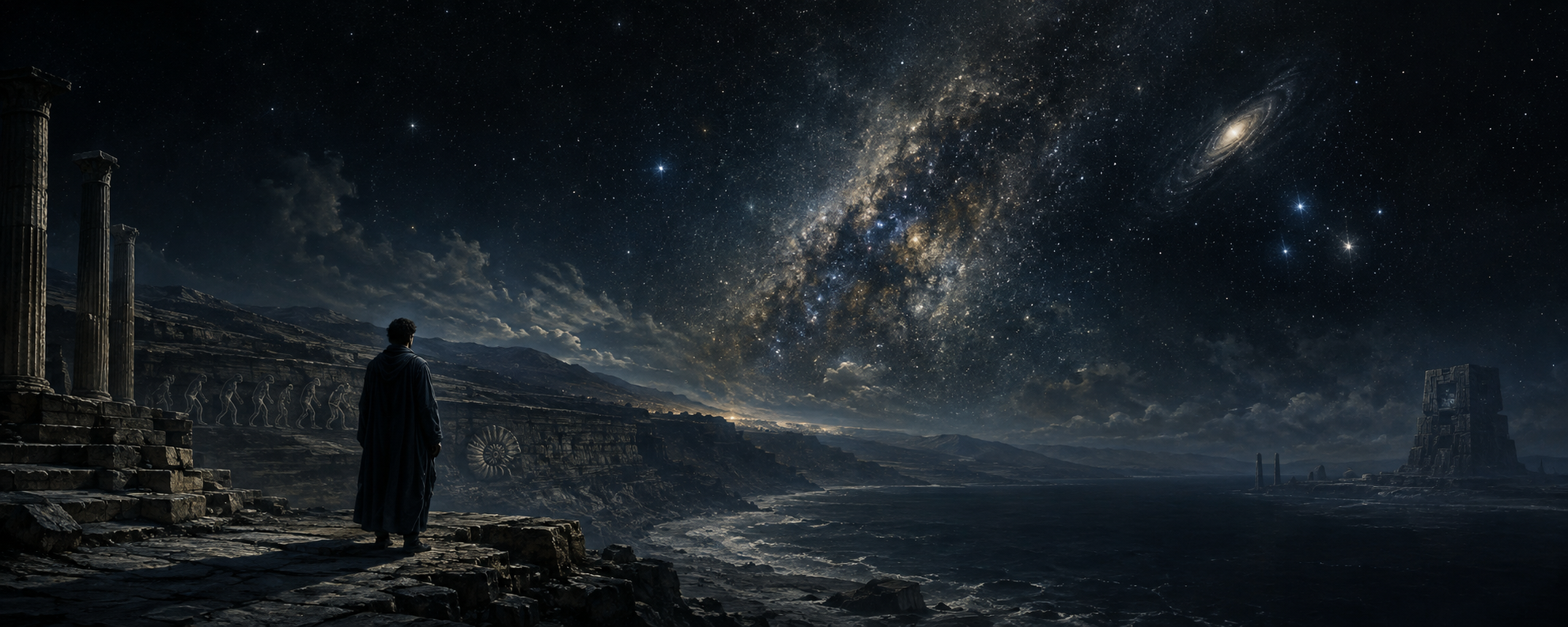
H. P. Lovecraft did not invent the idea that human beings are small, nor materialism, pessimism, scepticism, deep time, astronomical immensity or the suspicion that the universe may be indifferent to us. All had long histories before he began to write.
What he did was bring them together. What is now called cosmicism draws on nineteenth-century materialism and pessimism, Darwinian evolution, Enlightenment scepticism, astronomical decentring and ancient atomism.
Lovecraft's originality lay in turning that inheritance into an aesthetic: asking what familiar philosophical and scientific ideas might feel like when taken seriously.
His own account of the principle behind his fiction is unusually clear. In a 1927 letter to Weird Tales editor Farnsworth Wright, Lovecraft wrote that his stories rested on the premise that ordinary human laws, interests and emotions have no significance in the "vast cosmos-at-large". 1 It is difficult to get much closer to a manifesto of cosmicism.
The unsettling point is not simply that the universe is large, but that there may be no reason to suppose it is about us.
Antecedent is not the same as influence
Some care is needed before constructing a family tree for cosmicism.
Pascal, Hume or Epicurus can be philosophical antecedents of Lovecraft without our claiming that Lovecraft read a particular passage and consciously borrowed an idea from it. Other figures, such as Ernst Haeckel and Hugh Elliot, belong to a narrower category: there is good evidence that Lovecraft actually read them and incorporated aspects of their thought into his own.
The distinction is important. The history of an idea is larger than the history of somebody's bookshelf.
Cosmicism belongs to a long intellectual movement away from anthropocentrism. Lovecraft inherited some of that movement directly and some through the scientific and cultural atmosphere in which he lived. S. T. Joshi has shown in detail how Lovecraft's mature worldview combined ancient materialist sympathies with nineteenth- and early twentieth-century scientific naturalism. 2
The first indifferent universe
The oldest recognisable ancestor of cosmicism lies with the Greek atomists.
Leucippus and Democritus imagined reality as atoms moving through the void. Epicurus later developed atomism into a broader philosophy of nature in which supernatural intervention was unnecessary, the soul was mortal, and human beings were entirely contained within the natural order. Lucretius gave the Epicurean universe its great literary expression in De Rerum Natura . 3
There is already something recognisably cosmicist here: worlds form and perish, nature proceeds without consulting humanity, and the gods, if they exist, do not administer human fortunes.
The difference is emotional. Epicurus thought this was good news: if thunder is not divine anger, death is not the beginning of supernatural punishment, and the gods are indifferent to us, then understanding nature can free us from unnecessary fear.
Lovecraft inverts the same idea: for Epicurus, divine indifference is therapeutic; for Lovecraft, it becomes vertigo.
The loss of the centre
Another major precursor was astronomy.
It is easy to oversimplify the Copernican revolution. Medieval cosmology did not straightforwardly equate physical centrality with supreme spiritual importance. Nevertheless, the longer historical change is unmistakable.
Earth ceased to be the fixed centre around which the heavens revolved. The Sun eventually became one star among an enormous population. The Milky Way became one galaxy among others, and then one galaxy among billions.
Each enlargement of astronomical knowledge made it harder to regard the physical universe as transparently arranged around human beings.
Lovecraft felt this unusually strongly. Astronomy was one of the foundations of his intellectual life. He became fascinated by it as a child, produced amateur astronomical material, observed through telescopes and later wrote newspaper astronomy columns. His scientific writings repeatedly connect astronomy with the formation of his cosmic perspective. 4
For Lovecraft, the night sky was not merely scenery but philosophy.
Pascal at the edge of the abyss
Blaise Pascal makes a particularly intriguing precursor.
Long before Lovecraft, Pascal contemplated humanity suspended within immensities it could barely comprehend. In the Pensées he considers the brevity of a human life against eternity and the minute region of space occupied by an individual against the immensity beyond it.
Then comes perhaps the most Lovecraftian sentence written in the seventeenth century: "The eternal silence of these infinite spaces frightens me." 5
There is genuine cosmic vertigo here.
But Pascal is not a cosmicist.
He stands on the other side of the same abyss. For Pascal, human disproportion points eventually towards God. Humanity is physically wretched but intellectually extraordinary because we can recognise our own wretchedness. The frightening silence of space belongs inside a theological argument.
Lovecraft retains the silence and removes the answer.
Still, an important qualification presses against any easy inference from scale: physical immensity alone cannot establish cosmic insignificance. A universe could contain a trillion galaxies and still have been created principally for humanity; if a personal God intended human beings as the purpose of the whole arrangement, size would be largely irrelevant.
Lovecraftian cosmicism therefore appears to depend on more than immensity alone: vastness becomes characteristically cosmicist when joined to an apparent absence of providence.
Pascal looks into infinite space and asks who placed him there; Lovecraft looks into essentially the same darkness and sees no reason to suppose that anyone did.
Hume and the retreat of providence
David Hume belongs to the prehistory of cosmicism for another reason.
He weakened the intellectual confidence with which human purposes could be projected onto the universe. Hume's Dialogues Concerning Natural Religion subjects the argument from design to sustained sceptical examination. A house can reasonably be inferred to have a builder because we already possess abundant experience of houses being built. We possess no comparable experience of universes being manufactured. 6
Hume is not writing Lovecraftian philosophy. But something important has changed. The apparent order of the universe can no longer simply be assumed to bear human-like intentions.
Other Enlightenment materialists went further. La Mettrie treated human beings mechanistically. Baron d'Holbach described nature as a self-contained causal order without supernatural direction.
The direction of explanation had begun to reverse: instead of explaining nature through humanity, philosophers increasingly explained humanity through nature. That reversal is one of the intellectual prerequisites of cosmicism. Human beings cease to be the observers for whose benefit the universe has been arranged and become another phenomenon inside it.
Deep time
Astronomy made humanity spatially provincial; geology made it temporally provincial.
The gradual recognition of geological deep time radically enlarged the past. Human history, which seems vast when measured in kings, wars and civilisations, became almost invisible against the age of the Earth.
Lovecraft repeatedly turned this temporal disproportion into horror. His ruins and entities predate human civilisation; species rise and disappear; cities flourish beneath alien suns and are forgotten before human beings exist to forget them.
Deep time becomes a philosophical device: humanity does not stand near the beginning of the story, but arrives very late.
Darwin's more serious insult
Darwin completed another part of the dethronement.
Again, the important point is not simply that human beings evolved. It is that we emerged through the same broad natural processes that produced every other terrestrial organism.
That removes a conceptual wall. We may differ spectacularly from bacteria, oak trees or chimpanzees, but we do not stand outside the biological history that produced them.
Lovecraft enthusiastically accepted evolutionary naturalism, and Joshi identifies Darwin, Huxley, Haeckel and other nineteenth-century scientific thinkers as important elements in the formation of his materialistic outlook. 2
This matters more than mere physical smallness. A creature can be tiny and still be cosmically central; Darwin instead weakens the assumption that humanity is a separate order of being. Our brains, senses, emotions and tendency to seek purpose all have histories.
None of this proves that human beings lack special metaphysical significance, but it weakens the case for assuming it in advance.
Schopenhauer and the failure of optimism
Materialism still does not get us all the way to Lovecraft: one can be a materialist and remain perfectly cheerful. Lovecraft needed pessimism as well.
Arthur Schopenhauer provided one important precedent. His metaphysics is certainly not Lovecraft's mechanistic naturalism, but the emotional climate is much closer. Nature is not the expression of a benevolent providence. Striving does not culminate in universal fulfilment. Suffering is structural rather than anomalous. 7
Lovecraft knew Schopenhauer and shared some of this pessimistic temperament, but his mature cosmicism eventually moves somewhere colder.
Schopenhauer remains intensely concerned with suffering.
Cosmicism begins to ask whether the universe can meaningfully be described in moral terms at all.
Haeckel and Elliot: from precursor to actual influence
With Ernst Haeckel and Hugh Elliot we move from broad intellectual ancestry to much firmer evidence of direct influence.
Joshi identifies Haeckel's The Riddle of the Universe and Elliot's Modern Science and Materialism as especially important sources for Lovecraft's developing metaphysics. Haeckel made his "law of substance" - combining conservation of matter and energy - the organising principle of a monistic cosmos; Elliot made uniform natural law and the denial of teleology central to his materialism.2
For cosmicism, Elliot's rejection of teleology is particularly suggestive: a purposeless universe is one in which our expectation of purpose may itself be a local biological phenomenon.
The stars may not be failing to explain their purpose to us; perhaps "purpose" is simply the wrong category to apply to them.
The limits of human perception
Elliot also supplied another fruitful idea: human perception is radically limited.
We do not see reality simply as reality is. We detect certain wavelengths of electromagnetic radiation and call the result sight. We respond to a limited range of vibrations and call the result sound. Our nervous systems provide a biologically useful interface with the world.
There is little reason to expect evolution to have equipped us to perceive everything that exists.
Lovecraft immediately recognised the possibilities. Elliot pointed to the limits of human sight, including our inability to see ultraviolet radiation. Joshi connects this discussion with From Beyond (1920), where Crawford Tillinghast's machine expands the senses and reveals entities that had apparently surrounded us all along.2
This is cosmicism in miniature: the universe has not changed, only our access to it.
The horror comes less from something entering reality than from discovering how much of reality ordinary perception excludes.
The idea becomes subtler in The Colour Out of Space, whose title already admits descriptive failure: the phenomenon resembles a colour enough to be named as one, yet resists familiar sensory categories.
The disturbing possibility is that our nervous systems may be doing much of the hiding for us.
Russell beneath the same stars
Bertrand Russell offers an illuminating near-contemporary comparison.
In "A Free Man's Worship", Russell describes humanity as the unintended outcome of blind physical processes in a universe indifferent to human hopes. Human civilisation itself will ultimately disappear. 8
The resemblance to cosmicism is striking, but Russell asks a different question: what should we do about it?
His answer is essentially humanistic. The fact that the universe does not supply our values does not prevent us from having them. Human beings can still care about beauty, truth, compassion and justice even if the physical universe offers no guarantee that any will ultimately triumph.
That distinction is worth preserving. Cosmic insignificance does not entail moral nihilism: the universe may not care about suffering, but we can; human values may be local without being imaginary.
There is, however, counter-pressure. A theist can reasonably object that cosmic indifference is an interpretation rather than an astronomical observation, while a non-theistic moral realist can deny that objective value needs cosmic endorsement at all. Cosmicism settles neither dispute; its more modest force is to remove anthropocentric purpose from the default picture and ask what, if anything, can put it back.
Poe, Machen, Blackwood and Dunsany
Philosophy supplied many of the propositions; weird literature supplied the method.
Edgar Allan Poe was Lovecraft's most obvious literary ancestor. From Poe he inherited atmosphere, psychological dissolution, obsessive narrators and the movement of the mind towards experiences it cannot comfortably assimilate.
Arthur Machen brought hidden orders of reality and the terrifying suggestion that ordinary perception concealed something older and stranger. Algernon Blackwood made landscape and non-human nature overwhelming presences. Lord Dunsany supplied invented mythologies, remote gods and worlds in which humanity was no longer necessarily the measure of things.
Lovecraft himself treated Machen, Blackwood and Dunsany as masters of the weird tale in Supernatural Horror in Literature . 9
But Lovecraft transformed the inheritance.
Traditional supernatural horror generally depends upon a distinction between nature and something outside nature.
Ghosts violate death, demons intrude from another order, and magic breaks the normal rules.
Lovecraft increasingly dissolves this boundary.
His "gods" need not be gods. His monsters may be organisms. Magic may be misunderstood physics. Alien dimensions and non-human intelligences may be perfectly natural.
They are horrifying not because they violate nature, but because they reveal that nature was never obliged to resemble the provincial version constructed by human beings.
This is one of Lovecraft's decisive moves.
He does not merely remove God from the haunted house.
He makes the universe itself sufficient.
The horror of being wrong about reality
This brings us to what I think is the most distinctive feature of cosmicism.
Human beings may not merely be insignificant; we may also be cognitively provincial, and the difference matters.
Physical insignificance means that we occupy very little space and exist for very little time. Epistemic provincialism means that even the categories by which we understand reality may reflect the peculiar circumstances under which one species evolved.
Lovecraft's fiction repeatedly tests the assumption that the universe should be intuitively intelligible to human minds. His characters discover older chronologies, material 'gods', non-human civilisations, unfamiliar dimensions and unsettling truths about their own ancestry.
The catastrophe is often conceptual before it is physical: the world has not suddenly become strange so much as proved stranger than the protagonist understood.
This explains why knowledge in Lovecraft is so often dangerous. Lovecraft was not anti-scientific. Quite the contrary: science and astronomy were central to his worldview. 4
His more interesting suggestion is that there is no reason to assume truth will be psychologically comforting.
What Lovecraft actually invented
By this point, the main ingredients were already available: nature without providence, enlarged space and time, evolutionary continuity, pessimism, scientific materialism and a weird tradition capable of staging the unknown.
Lovecraft's originality was largely synthetic. In his hands materialism could become horror, astronomy perspective, evolution demotion, deep time vertigo and epistemology dread. The weird tale could often dispense with much of the traditional supernatural.
The human value of cosmicism
Calling the result nihilism is too easy. Cosmicism says that human values are not obviously written into the universe; it does not follow that they are unreal.
The Andromeda Galaxy presumably has no opinion about cruelty, but that tells us very little about whether cruelty matters to the person being hurt. No astronomical observation can make suffering painless, and no lack of cosmic purpose prevents human beings from creating purposes of their own.
There may be no celestial tribunal, no guarantee that injustice will be corrected and no providential mechanism through which suffering is redeemed. That does not weaken the case for decency; it removes the possibility of outsourcing responsibility.
Separated from Lovecraft's own less admirable human prejudices, this is where the cosmic perspective remains philosophically fertile.
It asks us to abandon the assumption that significance must descend from above. Human beings need not be the purpose of the cosmos in order to matter to one another, nor need smallness be confused with worthlessness.
Before Cthulhu
Cosmicism did not begin with Cthulhu; its ingredients had accumulated across more than two millennia.
Lovecraft made that inheritance experiential. We can calmly accept that humanity occupies no privileged astronomical position; he wants us to stand outside at night and feel it. We can acknowledge that our senses reveal only part of the physical world; he asks what might occupy the remainder.
He did not discover the indifferent universe; he gave its intellectual landscape an atmosphere and a literary form.
Cosmicism existed before Lovecraft in fragments. He made them look at us from the darkness and then suggested, more disturbingly, that they probably were not looking at us at all.
References and further reading
- H. P. Lovecraft to Farnsworth Wright, 5 July 1927, in August Derleth and Donald Wandrei (eds.), Selected Letters II: 1925-1929 (Arkham House, 1968), pp. 149-151. Lovecraft's related remarks on cosmic perspective are also collected in H. P. Lovecraft Archive: Quotes .
- S. T. Joshi, A Dreamer and a Visionary: H. P. Lovecraft in His Time (Liverpool University Press, 2001), especially the discussions of mechanistic materialism, Haeckel and Hugh Elliot. See also Joshi, H. P. Lovecraft: The Decline of the West , overview at The H. P. Lovecraft Archive .
- For Epicurean naturalism and Lucretius, see David Sedley, "Lucretius", Stanford Encyclopedia of Philosophy , plato.stanford.edu/entries/lucretius/ .
- H. P. Lovecraft's scientific and astronomical writings are collected in S. T. Joshi (ed.), Collected Essays, Volume 3: Science (Hippocampus Press, 2005). Bibliographic details at The H. P. Lovecraft Archive .
- Blaise Pascal, Pensées , Brunschvicg fragment 206. English text available at Wikisource .
- David Hume, Dialogues Concerning Natural Religion . For an overview of Hume's critique of natural religion and the design argument, see Stanford Encyclopedia of Philosophy: Hume on Religion .
- Arthur Schopenhauer, The World as Will and Representation . For a scholarly overview of Schopenhauer's metaphysics and pessimism, see Stanford Encyclopedia of Philosophy: Arthur Schopenhauer .
- Bertrand Russell, "A Free Man's Worship" (1903), later collected in Mysticism and Logic and Other Essays (1918). Public-domain text at Project Gutenberg .
- H. P. Lovecraft, Supernatural Horror in Literature , first published 1927 and revised thereafter. Text at The H. P. Lovecraft Archive .
- Ernst Haeckel, The Riddle of the Universe at the Close of the Nineteenth Century (1899; English translation 1900).
- Hugh Elliot, Modern Science and Materialism (Longmans, Green and Co., 1919).
- Edward Guimont and Horace A. Smith, When the Stars Are Right: H. P. Lovecraft and Astronomy (Hippocampus Press, 2023). Bibliographic details at The H. P. Lovecraft Archive .
Loading this essay’s discussion…