The Sleeper beneath the sea has grounds for complaint.
Point Nemo is the oceanic pole of inaccessibility, the place in the South Pacific furthest from land. The wider region has also become famous as a destination for controlled spacecraft re-entry. Lovecraft, meanwhile, placed R'lyeh in the same magnificently inconvenient part of the Pacific.
Pure coincidence, almost certainly. Yet the members of the H. P. Lovecraft Historical Society will appreciate the awkward optics. For decades, humanity has selected this remote part of the South Pacific as a convenient place to dispose of obsolete spacecraft. Lovecraft, with characteristically bad manners towards future aerospace agencies, had already placed R'lyeh nearby. At some point one must concede that repeated orbital impacts begin to look less like disposal policy and more like artillery.
The proposal is therefore to charter a suitable expedition vessel, sail to Point Nemo, and conduct a fully documented ceremonial deployment of a purpose-built bronze statue of Cthulhu. It would be, in equal measure, Lovecraftian ritual theatre, expedition engineering, documentary film and a small act of cosmic diplomacy performed by people who know perfectly well that the cosmos has not asked for one.
To Great Cthulhu, High Priest of the Great Old Ones, dreaming in his house at R'lyeh: humanity wishes to acknowledge that the repeated arrival of obsolete spacecraft in your general neighbourhood may reasonably have been interpreted as hostile bombardment. No offence was intended. We therefore submit this bronze likeness in token of apology, and respectfully ask that, when the stars are right, our conduct be judged with whatever leniency is compatible with aeons of slumbering wrath. Receipt should not be construed as acceptance.

Lovecraft, inconveniently, put it rather close.

Lovecraft's fictional coordinates for R'lyeh, and later variants used by August Derleth, lie remarkably close to the real Pacific pole of inaccessibility. This geographical accident is far too good to waste.
Point Nemo has acquired a second modern mythology because remote South Pacific waters have been used as a target region for controlled re-entries. The expedition's conceit is therefore straightforward: where aerospace agencies see a convenient uninhabited region, Lovecraftians may reasonably see a long-running failure of interspecies diplomacy.
A bronze idol for the house that is not dead
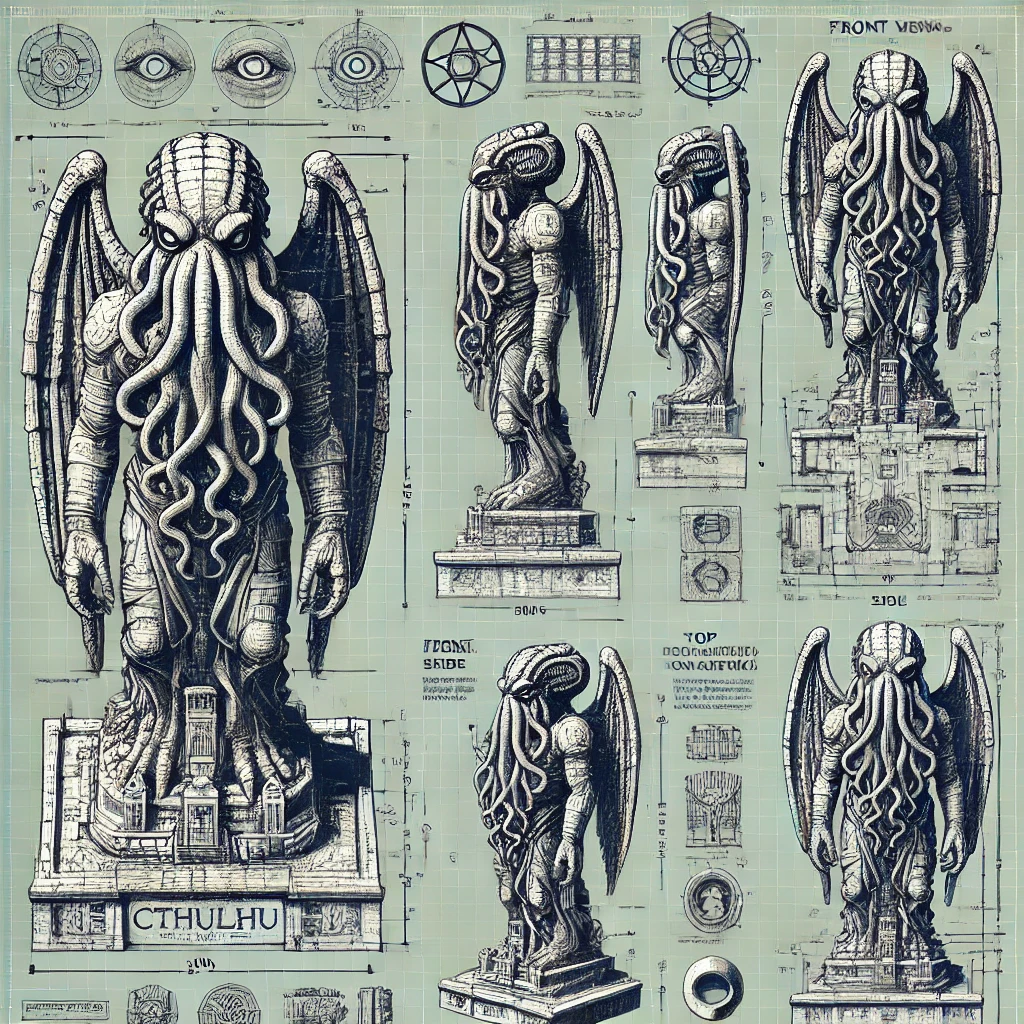
What began as a joke has, rather against its better judgement, started acquiring technical drawings.
The drawing at left is the best current visual anchor for the project: part sculptural proposal, part engineering conceit, and entirely in keeping with the notion that one might need to think seriously about lifting points for a Great Old One.
The descent should be witnessed.
A deep-ocean camera package would transform the deployment from a ceremony on deck into an actual descent into darkness.
The preferred system would use pressure-rated cameras, high-output lighting, depth and temperature instrumentation, onboard recording and an acoustic beacon. A recoverable camera pod could detach after touchdown and return to the surface, preserving the footage even if the statue remains below.
True live HD video at abyssal depth would require more elaborate tether or fibre infrastructure. A more practical first design is continuous local 4K recording, with live depth and position telemetry relayed to the ship.
Two cameras would be ideal: one looking outward into the water column, and another looking back at the descending figure. At some point the Sun vanishes, the surface ceases to matter, and the only visible object is Cthulhu continuing down through his own pool of artificial light.
Approximately £350,000 - before the architects of R'lyeh submit extras
The original rough figure of £250,000 remains a plausible lower bound for a stripped-down expedition. Once a genuinely substantial bronze sculpture and properly engineered abyssal imaging package are included, a public target closer to £350,000 is more credible.
| Item | Working allowance |
|---|---|
| Expedition vessel, crew, fuel and operating days | £140,000 |
| Bronze Cthulhu - sculpture, material, foundry and finishing | £95,000 |
| Transport, lifting frame and deployment engineering | £25,000 |
| Deep-ocean camera, lights, telemetry and recovery system | £25,000 |
| Insurance, permits, maritime and environmental advice | £15,000 |
| Film, satellite communications and documentation | £15,000 |
| Travel, accommodation and expedition support | £10,000 |
| Contingency | £25,000 |
| Indicative target | £350,000 |
These figures are deliberately provisional. Before crowdfunding, ship operators, foundries, insurers and marine contractors would be asked for indicative quotations. The project should not pretend that a number typed into a webpage has acquired the status of naval architecture.
A place in the bronze litany
A public campaign would need supporter recognition that is amusing, tangible and not too vulgar. One attractive upper-tier option is to allow major backers to have their names incorporated into the monument itself. Subject to the final sculpture design and foundry advice, this would most likely mean inscription on the plinth or on a dedicated bronze donor band wrapped around the base.
If space, engineering or legal constraints make direct inscription on the exterior impractical, an alternative would be a sealed donor register capsule within the plinth together with a visible dedication band naming principal supporters.
Platform note: an expedition berth would not be offered as an ordinary GoFundMe reward if the platform rules in force at launch prohibit goods or services in return for donations. It would instead need to be arranged separately and transparently, with its own terms, safety requirements and accounting.
For six people, Point Nemo would not merely be a coordinate.
A small number of major supporters could join the expedition itself and be aboard when the bronze Cthulhu leaves the daylight world.
The provisional figure is £20,000 per person, with no more than six civilian expedition berths. That level is intentionally benchmarked against specialist expedition-cruise pricing rather than ordinary passenger travel: this is a long-range voyage to the most remote point in the world ocean, aboard a vessel selected primarily for seamanship, lifting capacity and operational competence rather than the quality of the cocktail menu.
A Witness to the Descent would be aboard for the passage to Point Nemo, the formal apology ceremony and the controlled deployment of the statue, with access to the expedition record and the live depth and position telemetry available on the vessel. If the deep-ocean camera system performs as intended, they would also witness the recorded or relayed descent as Cthulhu disappears through several kilometres of increasingly indifferent Pacific.
The berth would include accommodation and meals aboard during the expedition and participation in the deployment event. Travel to and from the embarkation port, personal insurance, visas, medical certification and other individual expenses would normally remain the traveller's responsibility unless a final expedition contract says otherwise.
There are very few places on Earth where a person can plausibly say that the nearest humans may be aboard a spacecraft passing overhead. We cannot promise that exact circumstance on the day. We can promise that anyone swimming at Point Nemo will be a quite unreasonable distance from the nearest pub.
Final availability would depend on vessel capacity, operator approval, insurance, medical requirements, applicable law and the expedition configuration. The £20,000 figure is therefore a planning figure, not yet an offer for sale.
Even cultists require permits.
Deliberately placing or disposing of material at sea is regulated by international and national law. The London Convention and London Protocol exist precisely to control dumping at sea, and the Protocol adopts a particularly restrictive approach.
Accordingly, the permanent placement of the statue is an objective to be investigated, not something this draft promises. Before launch, the project would obtain proper advice on the flag state, departure state, applicable permits, environmental assessment and whether a permanent placement can lawfully be authorised.
If it cannot, the expedition still works: Cthulhu can be lowered ceremonially, filmed at depth, and recovered. There is something pleasingly appropriate about refusing to apologise for humanity throwing things into the Pacific by throwing another thing into the Pacific without permission.
If one must approach R'lyeh, one may as well take measurements.
A berth or instrument slot could be offered to an oceanographer, university group or citizen-science partner. Temperature, pressure, dissolved oxygen, water sampling, environmental DNA or other modest measurements could turn a theatrical expedition into an opportunity to collect useful observations from an exceptionally remote part of the world ocean.
The Lovecraftian objective gets the ship there. There is no reason the ship should return having learned nothing.
From private heresy to public expedition
Circulate the concept among HPLHS members and a small number of marine, engineering and sculptural contacts. Find the obvious holes before the Internet does.
Obtain indicative vessel, sculpture, camera, insurance and legal costs. Decide whether £350,000 is sensible or merely optimistic with better typography.
Launch the GoFundMe with a short film, final concept art, transparent budget and a clear statement of what happens if the full target is not reached.
Sail, document, deploy, measure, apologise, recover whatever must be recovered, and return before anyone notices the stars changing.
A word to the HPLHS before the stars align
Before this escapes into the wider world, I would rather expose it first to people who already understand why the sentence "we should apologise to Cthulhu for the spacecraft cemetery" is not self-evidently disqualifying.
The HPLHS seems the right first audience because this works only if the joke is treated with complete seriousness. I am not especially interested in turning it into a floating novelty event. I am interested in making something with the texture of a genuine expedition: proper ship, proper engineering, proper documentation, proper bronze, proper coordinates, proper absurdity.
I would particularly value thoughts on the statue design, the ceremonial wording, possible historical or literary details worth incorporating, and whether members know suitable oceanographers, marine engineers, foundries, expedition operators, filmmakers or other specialists willing to contemplate the enterprise without immediately backing away from the room.
If it develops into a public campaign, I would also like the HPLHS community to have the opportunity to shape the Lovecraftian tone before the idea is inevitably translated by the wider Internet into "people crowdfund giant sea monster".
We should, if possible, contrive matters so that future archaeologists discovering the bronze object four kilometres beneath the Pacific are left with considerably more questions than answers.Send comments to City of Dis
The apology should be read as though someone, somewhere, may be listening.
The final text would be written only after consultation, but the tone ought to be more diplomatic note than comedy sketch. No winking, no theatrical chanting unless it earns its place, and no attempt to improve upon Lovecraft by burying the thing beneath fake archaism.
Ph'nglui mglw'nafh Cthulhu R'lyeh wgah'nagl fhtagn.
To the Sleeper of R'lyeh: we come neither as conquerors nor as worshippers, but as representatives of a species that has repeatedly dropped machinery into your vicinity and only lately considered that this might be construed as rude. We offer bronze in place of debris, apology in place of bombardment, and our respectful hope that this distinction will be remembered when remembrance becomes relevant.
The familiar R'lyehian line is included here as an HPLHS-facing flourish, not as an attempt to present Lovecraft's invented language as a recoverable grammar.
Useful background
The International Maritime Organization describes the London Convention and London Protocol as the principal international instruments controlling dumping of wastes and other matter at sea. Under the Protocol, dumping is prohibited except for materials that may be considered under its specified exceptions. This draft therefore treats permanent placement as subject to legal and environmental review.
Map image: Ada Cukminski, "Location of Point Nemo in the South Pacific Ocean", CC BY-SA 4.0, Wikimedia Commons. R'lyeh comparison map: Nojhan, Wikimedia Commons. Preliminary statue engineering drawing supplied for the project discussion and converted to PNG for compatibility. See also the IMO pages on the London Convention and Protocol.
International Maritime Organization - London Convention and Protocol