The Poverty of Popular Apologetics
When Certainty Outruns Understanding
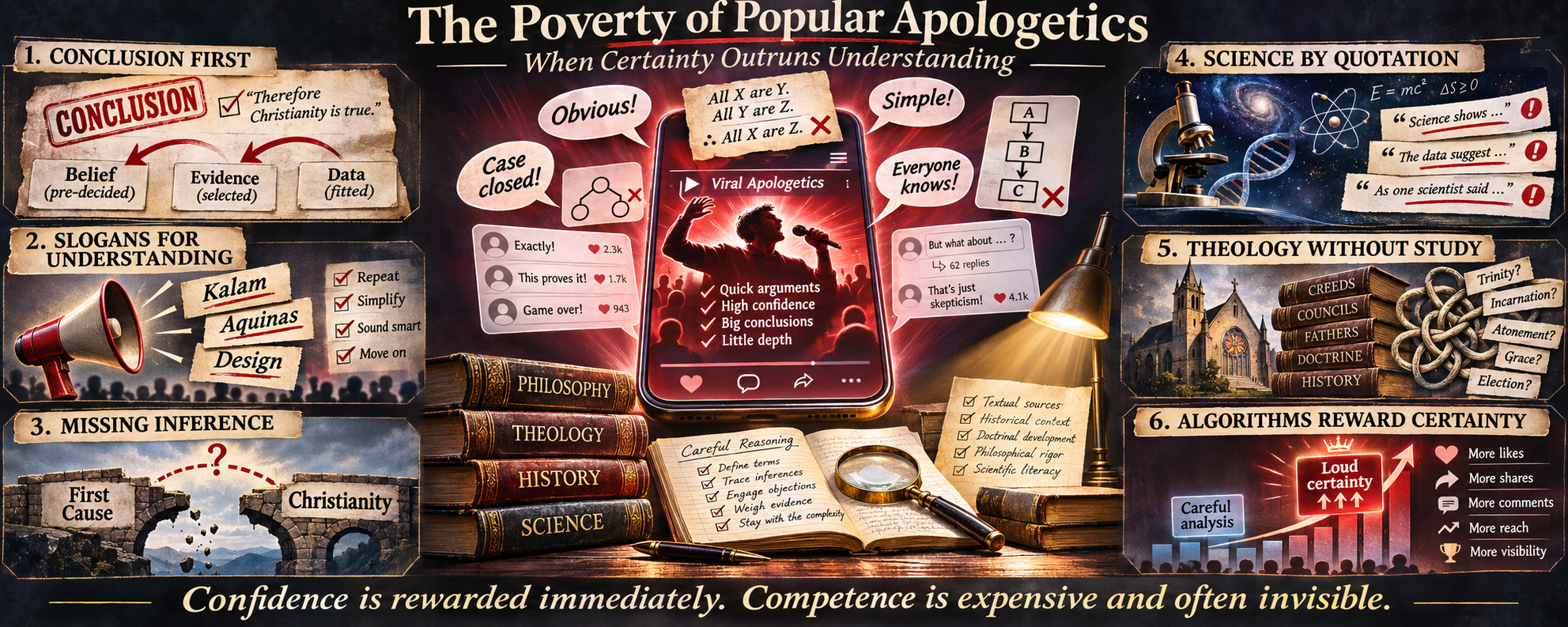
I think the generally poor quality of Christian apologetics on social media is the result of several mutually reinforcing problems. Some are peculiar to Christianity, others are consequences of social media, and a few are simply perennial defects of human reasoning.
But there’s one problem I regard as fundamental: much of popular apologetics is not an attempt to discover whether Christianity is true. It’s an attempt to demonstrate that Christianity must be true, beginning with that conclusion already firmly established.
That distinction has profound consequences for the quality of the reasoning.
01. The conclusion is frequently non-negotiable
In serious intellectual inquiry, conclusions are provisional. If the evidence contradicts a hypothesis, the hypothesis must be reconsidered.
In much popular apologetics, however, the conclusion is protected from revision. Evidence is interpreted, selected or dismissed according to whether it supports a commitment already made.
This encourages motivated reasoning, confirmation bias and increasingly elaborate rationalisations.
It’s particularly obvious in young-Earth creationism, where the age of the Earth is settled by a particular interpretation of scripture before geological or astronomical evidence is considered.
The central difficulty isn’t that Christians have convictions. Everyone does. It’s that some apologists treat their convictions as exempt from the standards of evidence they demand of everyone else.
02. Familiarity with an argument is mistaken for understanding it
This is perhaps the most conspicuous feature of social media apologetics.
Someone encounters the Kalam cosmological argument, Aquinas’ Five Ways, Gödel’s ontological argument or the transcendental argument for God. They memorise a simplified version, usually from another apologist, and imagine they’ve acquired a formidable philosophical weapon.
What they generally haven’t acquired is an understanding of the argument’s premises, historical context, technical vocabulary or substantial objections.
Consequently, we encounter people who confuse Aquinas’ essentially ordered causal series with a temporal succession of events, mistake logical possibility for physical possibility, or assume that the Second Law of Thermodynamics prohibits biological evolution.
What makes this especially frustrating is that these mistakes aren’t necessarily present in the original philosophical arguments. They’re introduced by people who haven’t properly understood what they’re repeating.
The result is philosophical terminology employed with considerable confidence and remarkably little philosophical competence.
03. The central inference is almost always missing
This is, to my mind, one of the most revealing defects.
Suppose, for the sake of argument, that an apologist establishes that the universe has a cause, that contingent existence requires some necessary foundation, or that the physical constants have remarkably life-permitting values.
None of those conclusions establishes Christianity.
Even if the premises and reasoning were entirely sound, an enormous inferential distance remains between a necessary being and the triune God of Nicene Christianity, or between a first cause and the historical claims of the New Testament.
Yet popular apologetics routinely treats that distance as though it didn’t exist.
Aquinas, whatever one thinks of his conclusions, understood that philosophical argument and revealed theology weren’t interchangeable. Many of his modern admirers seem not to have noticed.
This is why I frequently find myself asking apologists to identify the actual inference connecting their argument to the Christian conception of God.
Usually, I receive another assertion.
04. Science is treated as a collection of useful quotations
Much social media apologetics displays a distinctly opportunistic relationship with science.
Cosmology is authoritative when the Big Bang can be presented as evidence for creation, but apparently unreliable when geological and astrophysical evidence contradicts a young Earth.
Biochemistry is authoritative when DNA can be described metaphorically as information, but becomes suspect when evolutionary mechanisms explain how functional sequences arise and change.
Thermodynamics is enthusiastically invoked, often by people who don’t understand what an open system is.
The underlying problem is methodological. Scientific results are being recruited as rhetorical ammunition without the scientific disciplines that give those results their evidential value.
It’s science by selective quotation rather than science by investigation.
05. Theology itself is frequently misunderstood
One might at least expect Christian apologists to be competent in Christian theology. Unfortunately, that expectation is often disappointed.
Consider the confusion surrounding divine omniscience, free will, original sin, angelic rebellion, the Trinity or the nature of divine eternity.
Arguments are frequently advanced that conflict with substantial elements of established Christian theological traditions.
Aquinas is cited without understanding his metaphysics. Augustine is reduced to a slogan. The distinctions between Catholic, Orthodox and Protestant theology are ignored. Biblical texts are quoted as though two millennia of exegetical disagreement had never occurred.
Of course, Christianity encompasses numerous incompatible theological positions. But recognising that diversity is part of knowing the subject.
What’s particularly striking is the ease with which someone who’s never seriously studied historical theology will confidently pronounce upon what Christianity has always taught.
Confidence, unfortunately, is considerably easier to acquire than scholarship.
06. Social media actively rewards intellectual incompetence
The platforms themselves aggravate every one of these tendencies.
A carefully qualified philosophical argument is unlikely to attract the attention commanded by a confident declaration that atheism has been scientifically disproved.
Algorithms reward engagement, certainty, confrontation and novelty. They don’t reward intellectual accuracy.
Consequently, the successful social media apologist isn’t necessarily the person who understands the argument best. It’s frequently the person who can express it most provocatively.
The problem becomes self-reinforcing. Audiences reward simplistic arguments, creators produce more of them, and repetition eventually gives demonstrably defective arguments the appearance of established knowledge.
The result is an economy in which confidence is rewarded immediately, while competence is expensive and frequently invisible.
07. The intended audience often isn’t the sceptic
I suspect this explains a great deal.
Much apologetic content isn’t primarily designed to persuade knowledgeable unbelievers. It’s designed to reassure existing believers that intellectually respectable answers are available.
An argument needn’t survive sustained scrutiny to fulfil that function. It merely needs to sound convincing to someone already sympathetic to its conclusion.
This also explains the extraordinary persistence of arguments that have been comprehensively answered.
Their continued circulation doesn’t necessarily indicate that the objections are inadequate. It may simply indicate that the intended audience never encounters those objections in a serious form.
An apologist can therefore enjoy considerable success without ever having demonstrated anything to a genuinely critical audience.
08. There is no effective mechanism for correcting errors
In the sciences, and to a lesser extent academic philosophy and theology, arguments are exposed to institutional scrutiny. Claims are expected to survive criticism by people qualified to assess them.
Social media imposes no comparable requirement.
An apologist can misrepresent evolutionary biology on Monday, misunderstand Aristotelian causation on Tuesday, and announce the impossibility of objective morality without God on Wednesday, all without encountering any meaningful professional consequences.
When corrected, they can simply change the subject, block the critic or repeat the original claim to a more receptive audience.
Worse, criticism can itself be interpreted as persecution, transforming an intellectual failure into apparent evidence of religious commitment.
That makes error unusually resistant to correction.
09. The Dunning-Kruger problem, with an additional theological complication
I wouldn’t diagnose individual apologists with the Dunning-Kruger effect merely because they’re mistaken. But the broader problem of poor metacognitive calibration is plainly relevant.
Someone who doesn’t understand the distinction between deductive validity and the truth of premises may also lack the knowledge required to recognise that deficiency.
Add the conviction that one possesses an ultimate revealed truth, and intellectual humility can become even harder to sustain.
This isn’t inevitable. Some of the most intellectually sophisticated philosophers and theologians in history have been Christians.
Indeed, that’s what makes the current spectacle so disappointing.
There’s an enormous difference between engaging seriously with Aquinas, Augustine, Plantinga or Swinburne and repeating a five-line caricature of their arguments on X.
The existence of serious Christian philosophy makes the intellectual poverty of much popular apologetics more conspicuous, not less.
10. An important qualification: we’re observing a highly selected population
It would be a mistake to conclude that Christian apologetics as a whole is as poor as its social media representation.
There are accomplished Christian philosophers, biblical scholars, historians and theologians who understand the relevant objections and engage with them intelligently.
Equally, there is plenty of appalling atheist argumentation online. Scepticism doesn’t confer philosophical literacy automatically.
But social media selects for precisely the characteristics that make poor apologetics conspicuous: excessive certainty, oversimplification, tribal loyalty and a willingness to pronounce on subjects one hasn’t studied.
And apologetics aimed at defending a predetermined theological conclusion has an additional vulnerability to motivated reasoning.
That combination is particularly unfortunate.
My overall assessment
I think the most important distinction is between defending a belief because one has investigated its justification and defending an argument because it supports a belief one cannot contemplate abandoning.
The former can produce serious scholarship. The latter readily degenerates into rationalisation.
I also think there’s a significant difference between genuinely understanding an argument and merely knowing that an argument exists.
The typical social media apologist seems to have encountered a catalogue of purported proofs without acquiring the philosophical education necessary to evaluate any of them. The names are familiar, the terminology is impressive, and the confidence is inexhaustible. Unfortunately, the reasoning often fails at the first serious objection.
And there is a final irony.
Christian intellectual history contains some extraordinarily sophisticated thinkers. Augustine, Anselm, Aquinas and their successors spent centuries developing arguments of considerable philosophical subtlety, whether or not one ultimately accepts them.
To see that inheritance reduced to amateur misunderstandings of thermodynamics, assertions that DNA is literally computer software, and the conviction that everything which begins to exist must have a cause except one’s preferred deity is rather depressing.
My suspicion is that much social media apologetics succeeds precisely because its audience lacks the knowledge necessary to recognise how badly it fails.
The apologetic argument isn’t being tested by its capacity to withstand criticism. It’s being judged by its capacity to make believers feel that criticism has already been answered.
And in that environment, being demonstrably wrong is considerably less damaging than being insufficiently confident.