The Wrong Bone
The first thing Dr Eleanor Vale noticed was the articulation.
Not the size, although that was peculiar enough, nor the extraordinary preservation of a specimen recovered from sediments approximately five hundred and sixty million years old. It was the articulation, and particularly the small, almost delicate projection at the posterior end of what appeared to be a lower jaw.
She had been examining the specimen for nearly forty minutes before she allowed herself to recognise it.
There were, she thought, professional advantages to refusing to recognise the impossible.
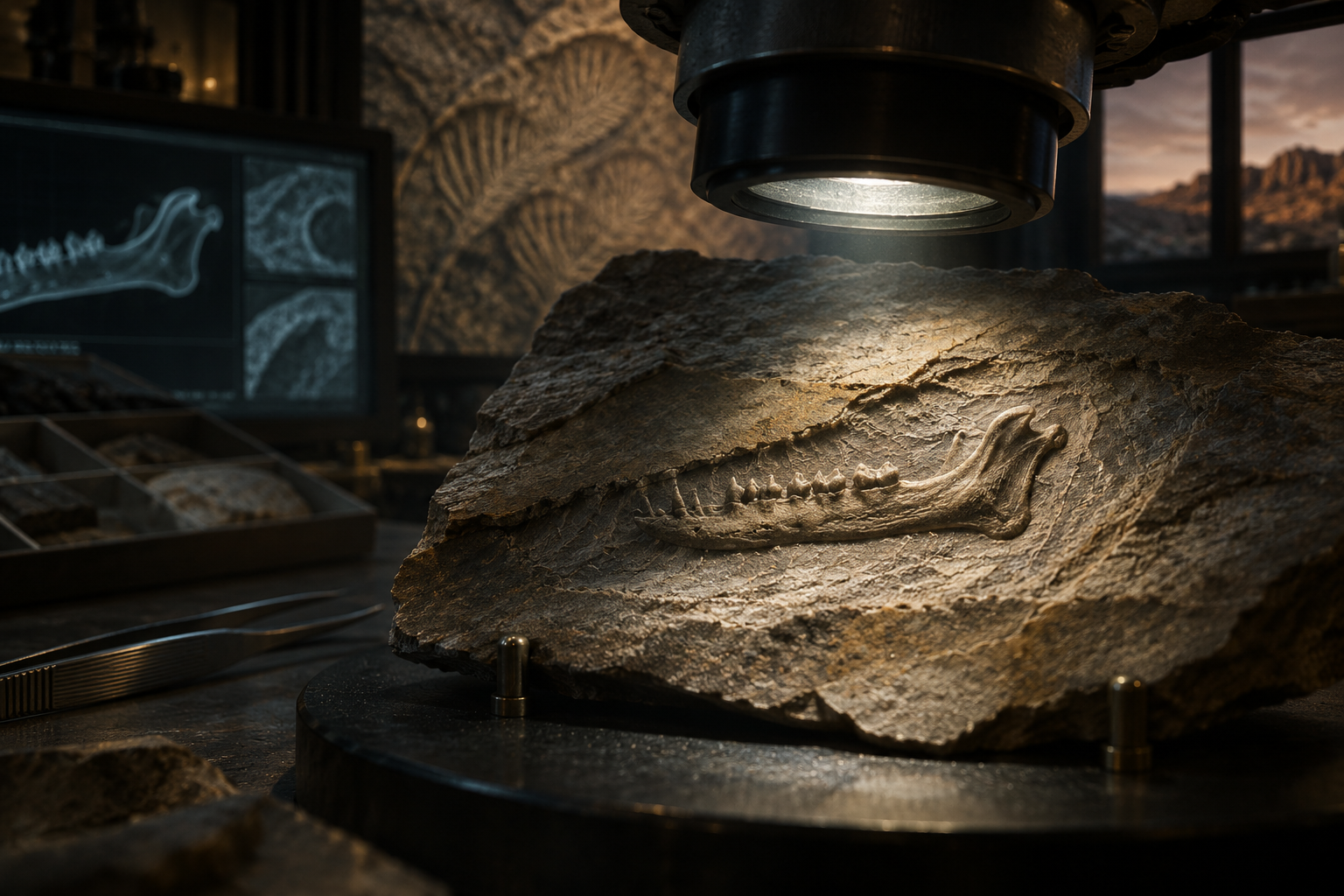
The fossil lay beneath the objective of a stereomicroscope in a laboratory at the University of Cambridge. It had arrived six days earlier, one of thirty-seven specimens collected from the Flinders Ranges. Most were unremarkable impressions of Ediacaran organisms, the soft-bodied inhabitants of an ocean whose communities were profoundly unlike anything familiar today.
This one was different.
It was nineteen millimetres long, dark against the pale sediment, and preserved with an anatomical precision that would have been remarkable in a specimen a hundred million years old.
At five hundred and sixty million years, it was absurd.
Eleanor adjusted the illumination. The projection cast a minute shadow. She rotated the specimen through fifteen degrees, brought the fine-focus wheel forward and examined it again.
Then she turned off the microscope.
‘Absolutely not,’ she said.
The laboratory offered no objection.
She was forty-nine, had published eighty-three papers, and had spent much of her professional life explaining why apparently revolutionary discoveries generally weren't. There was no particular reason to abandon that discipline now.
She switched the microscope on again. The projection remained where it had been.
It possessed the unmistakable geometry of a mammalian dentary condyle, part of the joint by which the lower jaw meets the skull.
The earliest vertebrates would not appear for tens of millions of years. The evolutionary history leading to the mammalian jaw joint lay hundreds of millions of years further into the future.
Nevertheless, there it was.
She opened the field documentation. Coordinates, stratigraphic horizon, extraction photographs, sample numbers, signatures. The specimen was visible inside undisturbed laminated rock before removal. Nothing in the record was conspicuously wrong.
She typed: Morphology inconsistent with documented geological age. Possible contamination or intrusive material. Further examination required.
She deleted possible, replaced it with probable, and eventually deleted the sentence altogether.
‘Bugger,’ she said.
Dr Michael Chen arrived shortly after nine the following morning with two coffees and an expression of habitual scepticism.
‘You said it was urgent.’
‘I said I wanted your opinion.’
‘At eight in the morning.’
‘Nine.’
‘You telephoned at eight.’
Eleanor took a coffee and indicated the microscope.
Michael studied the specimen for some considerable time.
‘Where did you get it?’
‘Flinders Ranges. Ediacaran.’
‘That's not what I asked.’
‘It's what I'm telling you.’
He looked up. ‘Eleanor. That's a mammalian jaw.’
‘I know.’
‘Someone has put a modern fossil in old rock.’
‘That would be my first suggestion.’
‘Your second?’
‘Labelling error.’
‘Third?’
‘Fraud.’
‘Fourth?’
‘I haven't got one.’
The micro-CT images arrived late that afternoon. They showed no insertion cavity or fracture through the enclosing laminations. The specimen's mineralisation matched its immediate matrix. Internal canals, tooth germs and remodelling surfaces appeared in the expected positions.
Michael stopped at one patch near the condyle.
‘That can't be right.’
‘Which part?’
‘There's a healed fracture.’
She watched as he traced a faint ridge through the reconstructed bone. They did not say what both understood. A healed fracture implied an animal that had lived long enough to be injured, and long enough afterwards to repair itself.
Not merely an anatomical shape. A biography.
The Inconvenience of Evidence
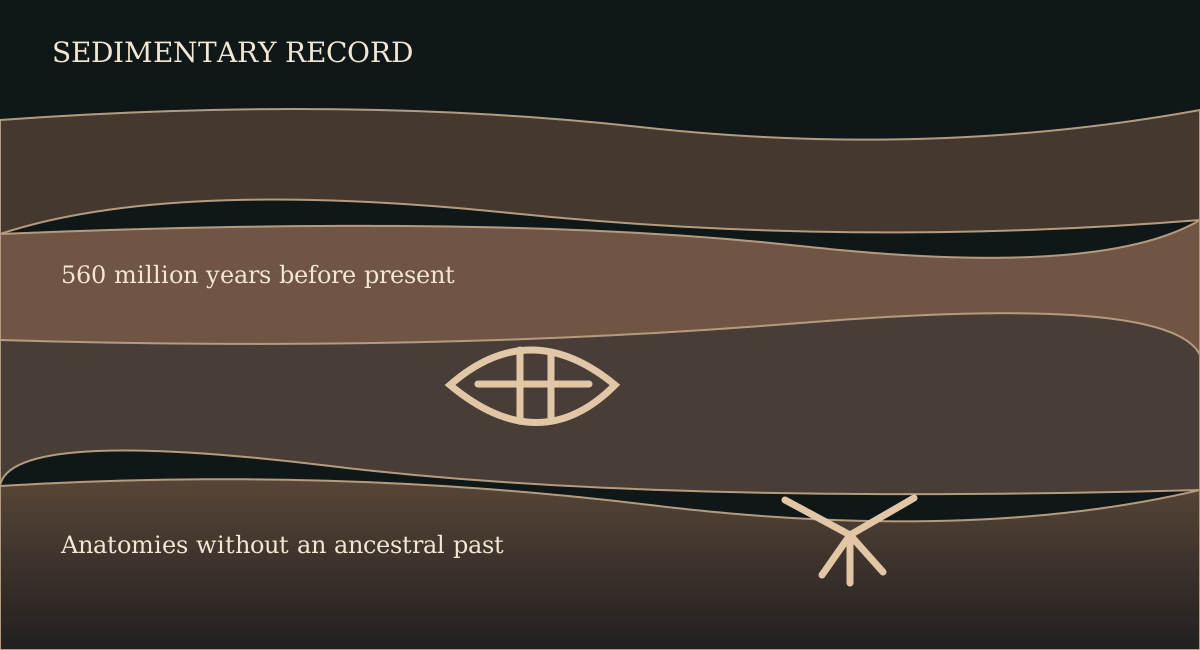
By the end of the next fortnight three laboratories had independently examined portions of the matrix. None could date the fossil directly by looking at it; they could, however, test the geological setting, the minerals and the sequence of deposition. The result was stubbornly consistent with the field records.
One reviewer suggested that the jaw had fallen through an ancient burrow. Eleanor sent him the original slab images, the microtomographic model and a polite account of why sedimentary laminae passing continuously above and below the specimen mattered.
He suggested a second burrow.
‘I rather admire his persistence,’ Michael said.
‘It's reassuring. At least somebody still believes the world is obliged to make sense.’
The second specimen came from a different collection. A hollow-boned fragment bearing the internal architecture of an avian limb had been catalogued years before as an indeterminate mineral concretion. The third appeared in a museum drawer in Adelaide. The fourth emerged from a Newfoundland field archive.
Those were the troublesome ones. There were also false positives: ordinary Ediacaran impressions, distorted mineral veins, a modern mouse bone found in a sample bag, and one ingenious forgery that fell apart under a dentist's X-ray machine.
They published the failures alongside the successes. Eleanor insisted on it.
Seventeen plausible specimens survived the first round of scrutiny. Five geological provenances. Several unrelated collectors. Different institutions, different years, different chains of custody.
It was possible, Eleanor explained to a hurriedly convened faculty meeting, that some unknown common error connected all seventeen. It was even possible that the anatomical identifications were all mistaken. But there was no longer a single convenient mistake that explained the collection.
Professor Hargreaves, who rarely spoke unless he had an opportunity to disapprove of something, asked whether the samples might be evidence that conventional evolutionary chronology was mistaken.
‘If you mean that mammals evolved half a billion years earlier than we think, no,’ Eleanor replied. ‘They would still require their ancestors. And those ancestors would require theirs. What we have is the end of a lineage without its beginning.’
‘Evolutionary theory is only a theory,’ Hargreaves said.
‘Gravity is only a theory. You are welcome to test your objection from the roof.’
The meeting was adjourned.
The press learned about the specimens four days later.
The usual machinery began: creationists announced the collapse of evolution, enthusiasts of ancient astronauts announced vindication, and a television producer asked whether Eleanor had considered the possibility of Atlantis.
She found herself longing for the comparative tranquillity of academic peer review.
A History in the Wrong Direction
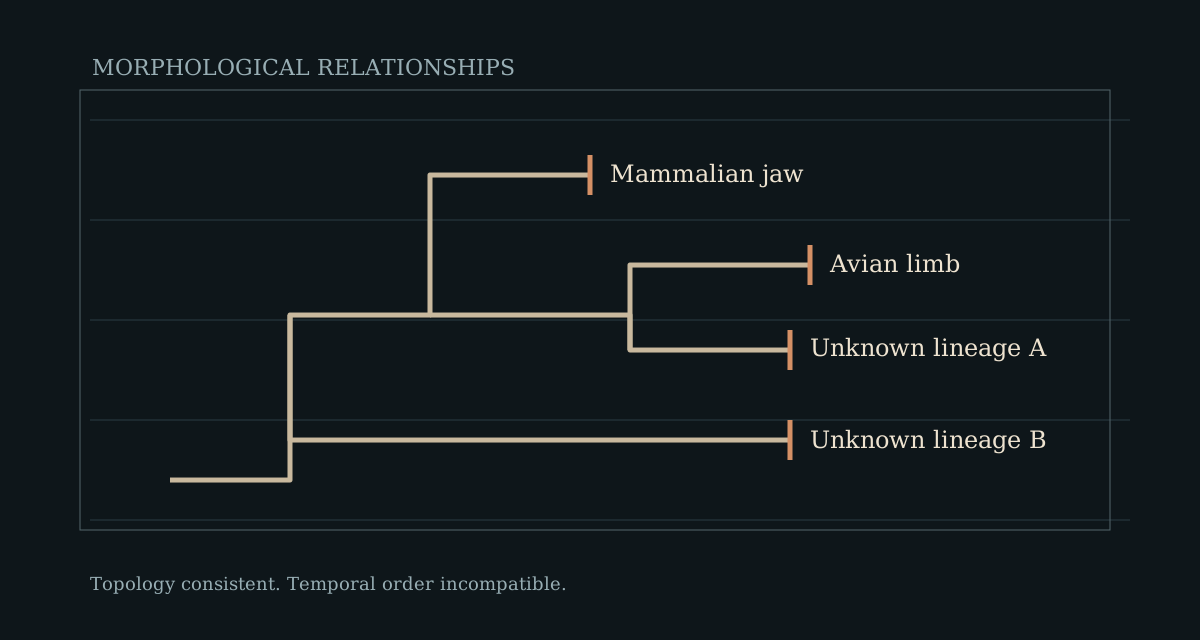
Michael constructed a morphological character matrix. The software compared structures rather than ages: joints, sockets, surfaces, muscular attachment points, vascular canals, tooth arrangements. It did not ask when a creature lived. It asked which forms could plausibly be related.
The computer produced an entirely unremarkable answer.
The putative mammalian specimens clustered with mammals. The avian fragments occupied plausible positions close to the relevant dinosaurian lineage. Several other specimens formed small, internally coherent groups for which no known relatives could be found.
When Michael added temporal constraints, red warnings accumulated across the screen.
Minimum branch duration violated. Ancestral occurrence younger than descendant. Chronological incompatibility.
‘It's impossible,’ he said.
‘You keep using that word for the thing we're supposed to investigate.’
He ran the analysis again, allowing the program to weight ages more heavily. The result was a grotesque tree, with distant animals forced together and close relatives pushed apart. The temporal fit improved only by destroying the anatomical fit.
‘If we trust the anatomy, the chronology is wrong. If we trust the chronology, the anatomy becomes nonsense.’
Eleanor examined the screen. ‘Don't confuse the limits of our model with the limits of reality.’
Michael smiled bleakly. ‘You usually say that to people who believe in miracles.’
‘Then perhaps I should have listened more carefully to myself.’
Three specimens belonged to an unknown group of small terrestrial animals. Their limbs, inner-ear structures and respiratory passages suggested a world with air denser than the present atmosphere and a markedly different distribution of oxygen.
An environmental modeller in Utrecht found a superficial fit with one speculative scenario for Earth's distant future. Eleanor dismissed the coincidence. Long-term forecasts were conditional constructions, not historical evidence, and the Earth would not kindly rearrange its atmospheric chemistry to suit a fossil.
Yet the notion would not leave her alone.
The fossils were anatomically related to animals that might exist. Their differences were not whimsical. There were plausible, stepwise routes from known ancestors to these forms. They were products of evolution. They simply lacked any preceding evolution in the rocks that contained them.
‘What if the missing part isn't a gap in the record?’ she asked Michael.
‘What else could it be?’
‘A gap in the past.’
The Unborn Fauna
For six weeks Eleanor refused to use the phrase future fossil. It appeared in the laboratory once, written on a whiteboard beneath a crude drawing of an animal wearing a wristwatch, and she rubbed it off.
The phrase presumed more than the evidence licensed. A fossil could not be from the future in the ordinary sense. Fossilisation required sediment, burial, mineral alteration and time. These things had happened. The rock had a history and it was old.
‘Then what is it?’ Michael asked.
‘Something for which we haven't got the right question.’
A newly identified specimen from the same formation made that answer less comfortable. It contained the remains of a parasite inside a host whose anatomy had no recorded lineage. The parasite itself possessed specialised attachment organs matched precisely to structures in the host. They were, improbably, adapted to one another.
‘Two evolutionary histories,’ Michael said. ‘Interlocked.’
‘Yes.’
‘Neither of which happened.’
‘Neither of which is in the history we know.’
Two weeks later, the group recovered a compact arrangement of vertebrae and ribs from a slab whose original collector had been dead for thirty years. The bones exhibited a congenital malformation. Nearby lay an adult skeleton of the same unknown form, apparently normal except for healed damage consistent with compensating for precisely that malformation.
They had evidence of development, disease, ecological association and long-term survival. They had a population without a period, an ecosystem without an epoch.
Eleanor stopped sleeping properly. Not from terror. Terror required an object, an event, some anticipated injury. She was suffering the more humiliating condition of having become unsure what she meant by before.
There were mornings when the ordinary world felt meticulously contrived. Kettles boiled. Buses ran late. Students lost their keys. Every action seemed to insist on a sequence of causes and consequences that her fossil cabinets no longer acknowledged.
She wondered whether the cabinets were mistaken.
It was the last comforting thought she had for some time.
The Error in Causation
A physicist named Nadia Sayeed joined the project in January. She had been introduced as an expert in the foundations of time, which Michael considered dangerously close to introducing a priest.
‘I don't think your fossils travel backwards,’ Nadia said after reviewing the evidence. ‘That would require the animals to have existed at some later date and then somehow arrived in earlier strata. Your specimens have ordinary geological histories. It's the evolutionary relationships that offend you.’
‘They offend nature,’ Michael said.
‘No. They offend the description you've made of nature.’
She drew a diagram. On the left was a familiar branching tree, its ancestors below their descendants, every line obediently moving from past to future. On the right was a network of relationships with no arrow indicating the direction in which it should be read.
‘A family tree is a description of causal history,’ Eleanor said. ‘Take away the direction and you're no longer describing evolution.’
‘Agreed. I'm not asking you to take it away. I'm asking whether the directions supplied by local biological processes must be identical to the order in which the entire physical history is constituted.’
‘That sounds suspiciously like philosophy.’
‘It is. Which is why it doesn't count as an explanation.’
Nadia put down the pen.
‘We have theories in which time is not a universal external clock. None predicts your fossils. None makes them likely. But the mistake would be to assume that because causal order works extraordinarily well in laboratories, it must be the primitive substance out of which every possible description of the universe is made.’
‘So the fossils are possibilities?’
‘Perhaps. But possibility doesn't usually leave bones.’
For a while that was all they had: an uncompromising statement of ignorance, and a growing collection of things nobody could explain.
Then they found two specimens of the same individual.
They were small animals, recovered from separate sites hundreds of kilometres apart, and possessed an identical and exquisitely improbable pattern of bone damage. Not merely the same congenital structure. The same sequence of old fractures and repairs, the same minute deformities, the same unusual tooth wear.
One skeleton had died young. The other had lived to great age.
Both were encased in rock deposited long before their lineage could have evolved.
‘They can't both be the same animal,’ Michael said.
‘No.’
‘And yet they are.’
Eleanor looked at the paired scans. One individual, two incompatible biographies, both preserved.
‘We've been asking which future they're from,’ she said. ‘Perhaps there's no single answer.’
The Fossils of Tomorrow
The human specimen arrived in a wooden crate from a private collection in Tasmania.
It had been excavated in the nineteenth century and miscatalogued repeatedly. The surviving field notebook described its discovery inside an intact Ediacaran bed, a claim Eleanor would have rejected immediately had it not been accompanied by photographs, mineral samples and a second slab that fitted the first with the precision of a broken plate.
The specimen consisted of portions of a human forearm and wrist. Its preservation was less complete than that of FR-27. Its meaning was considerably worse.
There had been surgery.
A narrow canal through one bone and the altered architecture of the surrounding tissue were consistent with an old orthopaedic intervention. Nothing metallic had survived, but the shape of the healed bone told a recognisable story.
Michael brought in a forensic anthropologist. She made measurements, examined the injury and compared them with anonymised modern clinical scans, initially without being told the age assigned to the rock.
A match emerged. Not a statistically secure identification on its own, and Eleanor would never have allowed it to be described as one. But the combination of anatomy, injury, surgical geometry and minor variations was sufficiently specific to justify an approach to the living patient.
His name was Daniel Mercer. He was thirty-six, worked as a railway engineer, and had broken his wrist in a cycling accident when he was nineteen.
He arrived at Cambridge believing that the university was conducting a study of uncommon bone injuries.
He brought his hospital records. The measurements agreed. When he saw the fossil, he laughed.
‘You've got to be joking.’
Eleanor wished very much that she had been.
A further scan revealed the feature they had missed. In the fossil there was evidence of a second fracture, above the old surgical site. It was entirely healed, but the direction and extent of the injury were distinct.
Daniel had no such injury.
‘So I'm going to break my wrist again?’ he asked.
‘We have no reason to think that,’ Eleanor said.
‘You've just shown me my arm in a rock.’
‘I've shown you a specimen that resembles your arm in ways we don't understand. That's not a prediction.’
He stared at her. ‘You don't sound convinced.’
‘I'm convinced that the distinction matters.’
Daniel went home. For several weeks Eleanor checked her email with increasing resentment at herself.
He did not fracture his arm.
The fossil did not alter.
Eventually she understood that she had been waiting for an event to confirm a chronology she had already admitted might not apply. Even her fear had been organised around the expectation that a thing in the past must become true in the future.
Daniel might break his arm. He might not. The fossil was not obliged to announce which.
One evening she returned to the laboratory after everyone else had gone and opened the cabinets. There were labelled fragments from animals that had lived, she supposed, and animals that had not. Some might one day become familiar. Others belonged to lineages that no future Earth would ever support.
Each had grown. Each had fed. Some had suffered. Some had reproduced. Their remains testified to ordinary lives that could not all have taken place in any one history.
She realised then what had most troubled her about FR-27. It wasn't the jaw joint, nor even the healed fracture. It was the modesty of the evidence. Nothing about the specimen had been arranged to instruct her. It was not a message, a warning or a threat. It was a scrap of bone, as indifferent to her bewilderment as every other scrap of bone she had ever examined.
The universe had offered no revelation.
It had merely failed to share her assumptions.
At two in the morning Michael found her at the microscope, looking again at the small projection on the first jaw.
‘Any conclusions?’ he asked.
‘Only a rather unpleasant one.’
‘Which is?’
‘We've always called fossils records of the past. Perhaps that's only what the ordinary ones happen to be.’
Michael considered this. ‘And the extraordinary ones?’
‘Records,’ she said. ‘Nothing more.’
Outside, Cambridge moved unremarkably towards morning. The streetlights went out in sequence. A delivery van passed under the windows. Somewhere, a bird began to sing.
Each event followed another, with all the familiar assurance of a world proceeding through time.
Eleanor watched the fossil until the first light fell across the desk.
She did not know whether the morning had happened before.
She did not know whether it would happen again.
And she could think of no reason why the universe should owe her an answer.